Image Slider

Friday, March 27, 2015

Project Engage: Living our LIves for a Sustainable Future Starts Right Here in our Community

By Stephanie Bartlett

When five year olds become social activists, what are the skills they need? How can they turn a passion or curiosity into a positive action that can influence society? My students’ most recent interest is climate change. Rather than be overwhelmed by the magnitude of this task, we are working to redefine the notion of community. This work starts with compassion. We live meaningfully and we listen. When we care for our space and the natural environment, we become able to look at the world and do our part to divert us from potential crisis. Climate change and the market economy are real threats to our planetary nature. We invited our students to take action in order to create change in our local community and beyond. Our five year-old students say they can do this and want to make a difference. Here is our story, aiming to inspire others with the notion that if we start local, change is possible.

Kindergarten students are learning the process of planning social action. We recently hosted a Sweater Swap / Echange des chandails for our community at the school’s Take Action Fair. First, we identified a cause that was important to us. We are concerned about the Arctic, so we planned to raise awareness about climate change by celebrating National Sweater Day in our school.

Then, we organized a campaign, inviting the community to donate gently used sweaters.

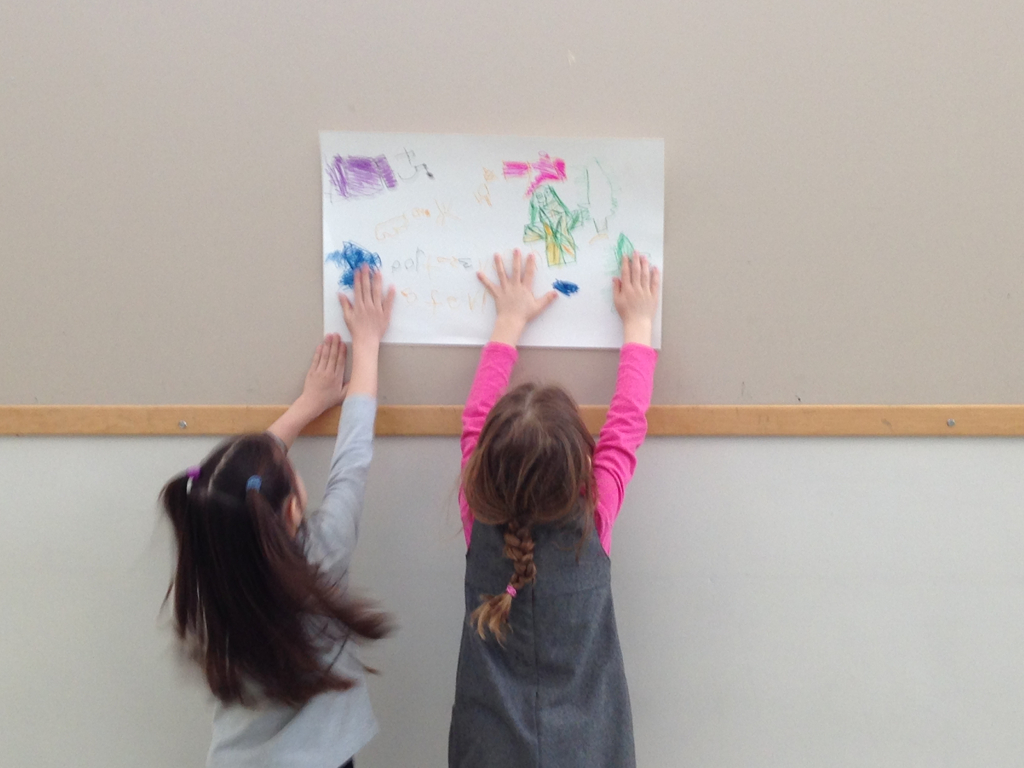
We spent a few weeks designing posters to educate the school and we worked with the growing number of sweaters in our classrooms.  

We sorted the sweaters into colours and patterns, counted them, and organized them into groups of small, medium and large. Traditional math and literacy skills were embedded in their project work.


 We had parent and grandparents come and teach us how to crochet and knit.


We researched arctic animals and created an arctic habitat in our dramatic play centre and the block centre became a market with booths to practice selling sweaters.


We built the market in the hallway and sold many sweaters.

We even measured the length of our customers’ arms to get the right fit!


After we counted the money, we wrote a letter to the World Wildlife Fund explaining how we earned over $200.00 to help protect the animals in the Arctic. The sweaters that we didn’t sell will be donated and sent to Haiti to be remade into different materials.Through these community initiatives, students are learning to be ethical citizens by caring for our planet and earning money to donate to the common good. 
Monday, March 09, 2015

Project Engage: The Story of How Kindergarten Students Are Creating Change

by Stephanie Bartlett

Kindergarten students are powerful, yet unlikely activists. As their teachers, we are teaching them the skills that will cause our community to wake up and take notice. With their enthusiasm, children may be the right ones to give us the nudge necessary to shift societal values. Our students are leading our school in serious learning work set up establish deeper relationships between school and community, in an effort to reduce our ecological footprint at a local level. We learn through determining an environmental concern, then educating others by organizing school-wide campaigns. We have established a fourth sector enterprise where a portion of the profit is kept for our own sustainability initiatives.  We give the majority to the common good, therefore teaching the value of ethical citizenship. As we say, if five year olds can do it, anyone can! Stay tuned for a series of stories of how we are teaching our students to take action.


Tuesday, February 24, 2015

If You're Lucky

If you’re lucky, you’ll be one good example. – Wendell Berry 
Darlene St. Georges, Branch II, 2011

We must tell the stories. We must tell an account of ourselves, tell what needs to be heard. There is so much noise in education.
“Mrs. Nelson, please call the office.” 
“Guaranteed to improve math levels by one full grade level in one year or your money back.” 
“You must take this exam seriously. It’s worth 50% of your grade.” 
“I’m concerned that my son is not learning basic literacy skills in your classroom.” 
“Province Cuts Education Budget by 8%” 
“I can’t spend time on that fun stuff. There’s not enough time. I have to cover the curriculum.”

Darlene St. Georges, Original Syntax, 2011

It is easy to despair. It is easy to become complacent, or cynical. The noise is exhausting. That is why it is even more important to tell our stories. The invitation is there. It’s really quite simple. We need to read, and appreciate how delicious language can be. We need to write, and talk, and tell what needs to be told. We need to listen. We need to listen deeply. There are openings here, for the very human gesture of response. And if we offer these opportunities, our students will rise to the invitation and will do things they never thought imaginable.

And we as teachers need to tell these stories. We need to tell of how we speak, how the words we use make our students not even think about asking for their grade at the end of a project. We need to share how we open up the possibility of our students to be artists, even in math class, and how this gives them permission to leap, no matter the consequences. We need to come from a place of our greatest strengths, but we, and our students, need to take risks and try new things. We need to show how education can be a practice of freedom, of opening up, rather than boxing in. We need to find a way for there to be more coulds than shoulds.
It’s a matter of practice. And we must practice it, to overcome this discourse of boxes and assembly lines and shoulds. We must be one good example. And be grateful that we are lucky enough to do so.
Darlene St. Georges, Tree, 2011

Inspired by the Provoking Curriculum Studies biennial conference, February 20 & 21st, 2015 in Vancouver, British Columbia.