Image Slider

Showing posts with label renaissance. Show all posts
Wednesday, July 14, 2021

Redesigned Bocca al Lupo: A Game to Learn about the European Renaissance

Updated Summer of 2022

As a part of our regular practice, my teaching partner Tara and I systematically reflect on our practice. This reflection practice holds us accountable: to our students, to best practices in task design and assessment, and to ourselves.

We designed Bocca al Lupo in 2019 (click here to view a previous post about this game). Bocca al Lupo is a card game that we co-design with our students. It was initially designed as a card game that was a kind of mashup between Pokemon and War. We thought what we designed was pretty good. In essence, the students participated in "levels" where they chose a Sosantivo (Italian for "noun" - so a person, place, thing, or idea) of several possibilities and then created a card highlighting this Sosantivo's strengths and weaknesses. The students learned so much about the different ideas that emerged from the European Renaissance. They were also super engaged in the process. In our reflection practice, though, we realized that though they learned a lot, what was lacking was the big picture view of the changes that emerged during the Renaissance, and were missing the connections to broader ideas and trends that are so significant to our modern Western worldview. 


With social studies, we always want our students to come away with a bigger picture idea. Why do we learn about history? Learning about historical significance helps us understand why some ideas become so important to a culture's worldview while other ideas don't. In thinking critically about historical significance, we can look at our society now and understand why we behave in the way we do, and trace these roots to ideas that shaped our past. The study of the Renaissance is really about looking at the origins of a Western worldview - a worldview we can recognize here in North America today. 


So, we redesigned the game. Because we wanted this to be about making connections between ideas, we swapped the Pokemon/War game mechanic for another one: dominoes. The game of dominoes is all about making connections. This is a perfect example of why game-like learning fits in teaching and learning. We can use analogous concepts from games to help us reach our educational goals. For Tara and I, game-like learning isn't about gamifying - associating extrinsic rewards like points or avatars to traditional learning tasks. It's about borrowing concepts from games to design tasks around, leading to learning experiences that are intrinsically motivating and fun


The redesign is centred around the concept of "Powers." These are big ideas that emerged from the Renaissance or were a significant idea during the Renaissance that endure in some way today. The Powers we decided to centre on this year were: Competition, Democracy, Ethnocentrism, Feudalism, Hierarchy, Humanism, Imperialism/Colonialism, Monarchy, Monotheism, Oligarchy, Rationalism, Republic, Secularism, and Urbanization. We don't think we've quite hit on the perfect combination of Powers yet. Some worked better than others, which is kind of the point in that it makes the game more challenging as some concepts are more difficult to connect to. But others are hovering close to an idea that would be more appropriate, we think. 


In the 2021-2022 school year, we added minilessons to teach about these Power concepts. We taught one minilesson per day for the first seven days of the project. 
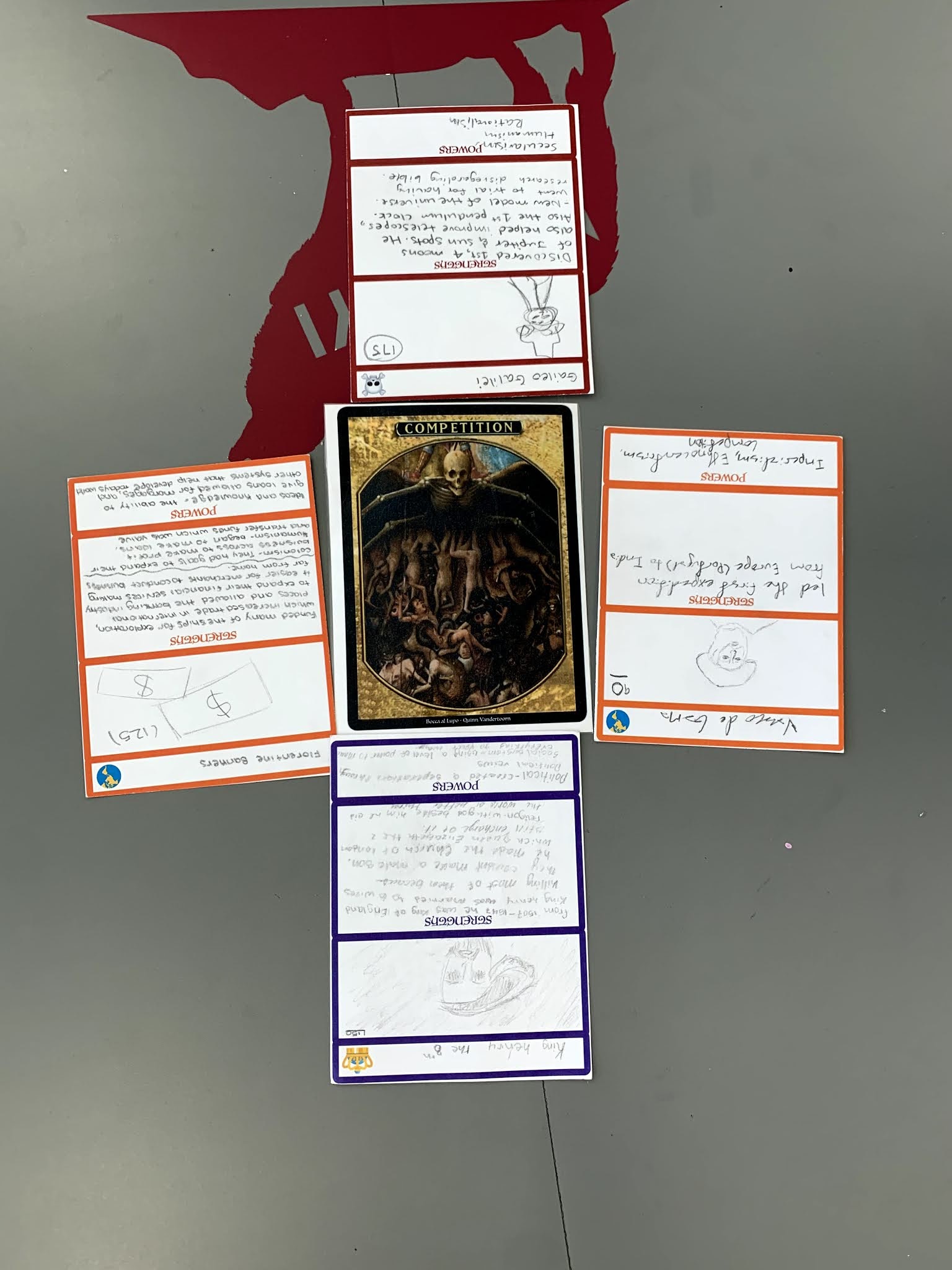

As they complete each level of the project in preparation for gameplay, the students create a card with a different Sosantivo. On the card, they draw a sketch of the Sosantivo, identify strengths, and make connections to Powers to which the Sosantivo relates. They complete seven levels, each one focused on a different aspect of the Renaissance: Arts & Culture, Math & Science, Religion, Trade & Travel, Politics, Technology & Innovations, and Philosophy. The student works through some research to learn about the Sosantivo, its role during the Renaissance, and use inferential and critical thinking to connect it to the Powers.

After the seventh level, the group has a full deck of cards and they're ready to play! Gameplay begins with the random drawing of a Power card, which is placed in the middle of the table. Then, each team randomly draws five cards from their full deck. To play the game, the team must play their cards, making connections to the Power Card or to other cards that have already been played. If they cannot play, they must draw another card from their deck. The object of the game is to be the first team to play all their cards. 


Students will be more successful in the game if they have a good understanding of the connections between Powers and Sosantivo. Because each student focuses on completing a singular card during each level, collaboration is essential for success in the game. The more the students on the team collaborate with one another to learn about each Sosantivo and deeply understand the connections between then, the better they will do in the game.


One of the key principles we kept front and centre during the design of this game was that students should have multiple opportunities to demonstrate a skill, and feedback should help them move their learning forward. We made another change this year to how end-of-level assessment worked. Whereas in the past. assessment took place in a group discussion, where we talk about the Sosantivos, their connections, and the big picture ideas they are noticing during the level, this year we shifted this to a simulated round of gameplay with the group. We chose a Power Card or two and played a sample round, where each student played a card and connected it to the concept or another card. As we progressed, we added a challenge of them having to play a card they did not create.

An iteration we made in 2020-2021 was to give each student a feedback tracking sheet, which they kept in front of them during these assessment conversations and gave them a place to record feedback. We were very explicit in these conversations about what specific changes they could make in the next level to improve their progression towards our standards. We noticed that this feedback tracking sheet really helped students know what they needed to do to improve. Most students were hitting all the standards by the end of the seven levels.


We're happy to share our resources with you. Use them as-is, or hack them. If you do, we'd love to hear how it goes! E-mail us to let us know: elquinn@cbe.ab.ca and tabroshvandertoorn@cbe.ab.ca.

Here are links to Google Drive files with all the necessary files. If you'd rather just go to the whole folder, here's the link.

  • A slidedeck to guide the game creation process
  • An instruction manual to play the game
  • A flowchart that shows the process of a level
  • Player One Ready, the notecatcher students complete during research, as well as a modified version for students who need more structure/guidance.
  • The Levels folder, with handouts for the research pages to help them complete the Player One Ready sheet.
  • Levelling Up, a notecatcher for the students as they prepare for their end-of-level conference
  • Powers Sheet, to help students keep track of each of the Powers and their definitions
  • Minilessons on the Powers.
  • Assessment Classlist, for the teacher to use during assessment of each level
  • Feedback Tracking Sheet, for students to use to collect and track feedback to move their learning forward
  • Links to folders with all the cards in Photoshop file format: 
    • Student Cards, which are the cards to play the game
    • Power Cards, which are used to begin the game
    • Boost Cards, which are awarded to the group at the end of each level based on their collective ability to make strong connections
    • Judgment Day Cards, which are awarded when a player challenges another player during the game, where students can object to a weak connection. A mini debate is then had, which the Questmaster (teacher) judges and awards a card based on the strength of the argument
    • Quest Cards: If a student completes their research before other member of their team are ready, they can complete a Quest - a short challenge that extends and deepens their understanding. The reward is a Quest Card, which is a valuable card that can be used in gameplay.
Please reach out if you have any questions or to share your ideas with us! The whole point of this post is to explore how reflection helps us iterate to be better, so we welcome your ideas to help us do that!

Connect with us on Twitter: Erin & Tara

Tuesday, July 30, 2019

Boca al Lupo: A Game to Learn Historical Significance and the Renaissance

Boca al Lupo
Italian, "from the mouth of the wolf"
An expression, often used in theatre, to wish someone good luck.

When it came time for us to begin our first major case study about worldviews, a look at how ideas spread during the Italian Renaissance, and how a Western worldview emerged, we were totally stuck. We looked at things other people had created, and projects we'd done in the past. One huge problem with this interesting, yet very history-focused curriculum, is that many teachers tend to focus on content (what happened) rather than phenomena and significance (why it matters).

We knew we wanted to focus on the latter. We had a couple of frustrating planning meetings with our Humanities team, which consisted of my incredible team partner Tara, and my student teacher Adrienne. Finally, a conversation that took the form of plussing happened - where we took an attitude of "yes, and" and added on to another person's idea. We were talking about games and principles of game-like learning, and the seed of Boca al Lupo was born. Boca al Lupo is essentially a smashup of Pokemon cards and War.

Here's the premise of Boca al Lupo:

  • Students are organized into teams of 5-6 people, called Guilds. The students give the guild a name, a motto, and a coat of arms (after a little minilesson on European heraldry).
  • There are seven Levels in the game creation. Each Guild works on one level at a time, in whichever order they want. The levels are: Arts/Culture, Math/Science/Health, Philosophy, Political Systems, Religion, Technology, and Trade/Commerce/Competition. We created a package for each level, in which we found grade-level information about topics and people of significance in that area during the Italian Renaissance. For example, in Arts/Culture, we featured Christine de Pizan, Humanism, Leonardo da Vinci, Michelangelo Buanarotti, The House of Medici Patronage, and William Shakepeare.
  • The students worked through each level with their Guild. Each member of the Guild was responsible for creating one card for their deck of Boca al Lupo cards. They each chose one of the people or topics from the level to research and create a card for. They used a graphic organizer called Player One Ready to organize their research. We had a complex version and one that was a bit simplified for our students who needed it. We also had a sheet called Leveling Up! which I'll talk about in a minute. We borrowed many of the concepts on the Ready Player One sheets from the Historical Thinking Project. Here's the sheets:

  • After each student was finished their Ready Player One sheet, the group would get together to complete the Levelling Up sheet together. They would share what they learned about their own person or topic with the group, and then assess the level of historical significance together, creating a kind of ranking of the topics or people in terms of how historically significant they were. The group would have 200 Health Points (HP) and Damage Points (DP) to divvy up when they got to their hard creation, and this ranking would help them do this. It also ensured that people in the group were familiar with all the topics in the level. We wouldn't want someone, for example, not knowing what humanism was all about because they'd researched William Shakespeare.
  • After this point, the group would call their Questmaster (which is what the teachers were called during the game. I wore a cape. It was amazing) over for an interview. We used an assessment sheet to keep track of how each student was doing during the level.

I want to break here to talk about assessment for a moment. One of the principles of game-like learning is "Feedback is immediate and ongoing." Feedback is one of the reasons why playing games is fun. You get instant and continuous feedback about how you're doing. We wanted to make sure this was part of the way this project worked, so we developed the interview. This made sure that groups were getting feedback before they went to create their cards. It gave us time to check for understanding from each student. We talked to the group about what they'd learned about, and made sure they knew the historical significance. It gave us a feedback loop in case the students had missed something pretty important. If they thought humanism wasn't particularly historically significant, we could give them some feedback about what else they needed to read or research to get a more complete understanding of the topic. We did one interview per group per level.

This meant seven opportunities to check in on the learning for each student. This meant seven chances for a kid to show their progress on each stem (we use our report card stems in a very similar way to how you'd see standards or objectives used in standard-based grading and objective-based assessment). The content would be different for each attempt, but the skills are the same. We were looking for growth for each student over time, and kept a master record of each student for each level as we did the interview. I used Checkmark, Checkmark Minus, and Checkmark Plus symbols to note which students had strong understanding and more tenuous understanding for each skill. If a student did not meet the objective at a basic level, he/she was given feedback and asked to continue working on their research and then we'd have a follow up interview to check for understanding again. As a result, no students were working below grade level on this project.
  • When the interview was complete, and all students had at least a basic understanding of the objectives, students were given two things: a boost card (worth 2x, 3x, or 4x the Health Points) based on how well the whole group understood their topics, and blank card templates.
This is where the 200 HP and DP come in again. The group had 200 to distribute amongst the group's cards. They could decide as a group how to do that, but they had to be able to justify their allocation. They gave each person or topic two strengths and a weakness. For example, a strength of the Black Death might be "Kills 2/3s of all human cards" or "Kills nobility and peasants equally. Roll a dice. If you roll less than 3, your card is automatically killed." A weakness could be "Demolishes the feudal system. All lower class cards increase their HP by 30." They combine their knowledge of the historical event or person, and bring in elements of gameplay to have the card influence the play. In the box at the top, they'd also draw a picture.


  • At any point in the level, if they finished their job earlier than the rest of their guild members, they had an opportunity to do a side quest. Side quests were an extra task for them to do, adding an element of enrichment for those who needed it. Quests would be things like, "Learn the meaning and context of 5 Shakespearean insults and then write one of your own, to be used during game play" or "Research one-point linear perspective then use it to create a drawing of a hallway or room in the school." Quests would give the group a bonus card that would benefit them during gameplay. The quest cards were made by Tara using a website called MTG Cardsmith!


  • Once all the cards were created, then the group could move on to the next level, and start the process all over again.

Once all groups had progressed through all seven levels, then they had a deck of cards that they would play the game with. Gameplay looked like this: We created a double elimination tournament bracket so each group would play at least twice. They would put five cards down on the table as their "bench," which is how Pokemon works. Then they'd turn the cards over in that order. Whatever was written as the strengths and weaknesses was applied. If neither card was eliminated, it went down to HP and DP to determine the winner. The winning team kept both cards, and could use them in future gameplay. Sometimes, there were disputes about a card having an unreasonable amount of power for its historical significance. At that point, they called a Questmaster over to hear the arguments and make a decision. This turned out to be a great chance for students to use persuasive skills and logic to present an argument. 


The final game came down to these two cards: Humanism vs. the Printing Press. We had to call it a tie.

As always, we have some changes we'd make next time. Most importantly, we need to figure out a better way to differentiate for students who have unique learning needs. Though we did create modified versions of the graphic organizers, students who needed modified work struggled with this task more than they should. All students should have pathways to excellence, and if a student didn't do a great job on their card, the card wouldn't be very useful to the group. We need to create a pathway to excellence for all students in this game. We don't yet have an idea for how to do this, but it's a definite redesign next time.

We'd also do a trial game early into the process, maybe after two levels, so the students can see how the gameplay works, which will give them feedback about how to improve their cards. We were kind of figuring this out as we were going through it so we didn't do this, but this would be an easy thing to incorporate next time.

Overall, we were happy to know that each student understood factors that shaped the Renaissance and the emergence of a Western worldview and were successfully able to employ historical thinking to determine historical significance.

The two Questmasters, debating a challenge

Resources Shared: