Image Slider

Showing posts with label sustainability. Show all posts
Friday, March 27, 2015

Project Engage: Living our LIves for a Sustainable Future Starts Right Here in our Community

By Stephanie Bartlett

When five year olds become social activists, what are the skills they need? How can they turn a passion or curiosity into a positive action that can influence society? My students’ most recent interest is climate change. Rather than be overwhelmed by the magnitude of this task, we are working to redefine the notion of community. This work starts with compassion. We live meaningfully and we listen. When we care for our space and the natural environment, we become able to look at the world and do our part to divert us from potential crisis. Climate change and the market economy are real threats to our planetary nature. We invited our students to take action in order to create change in our local community and beyond. Our five year-old students say they can do this and want to make a difference. Here is our story, aiming to inspire others with the notion that if we start local, change is possible.

Kindergarten students are learning the process of planning social action. We recently hosted a Sweater Swap / Echange des chandails for our community at the school’s Take Action Fair. First, we identified a cause that was important to us. We are concerned about the Arctic, so we planned to raise awareness about climate change by celebrating National Sweater Day in our school.

Then, we organized a campaign, inviting the community to donate gently used sweaters.

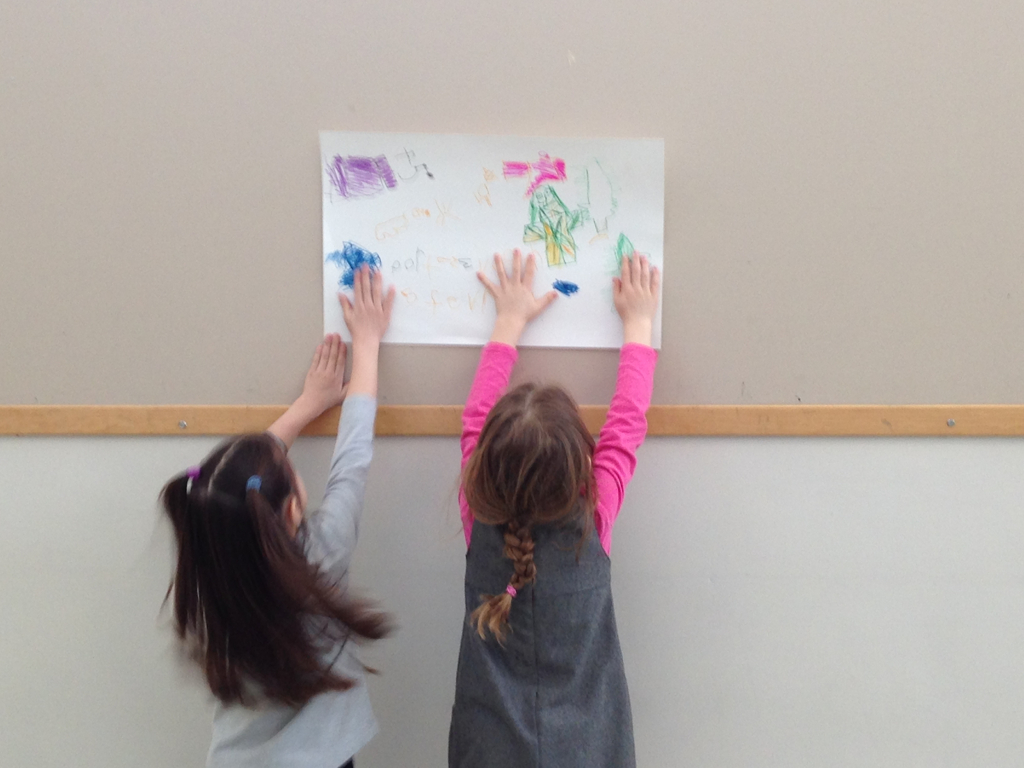
We spent a few weeks designing posters to educate the school and we worked with the growing number of sweaters in our classrooms.  

We sorted the sweaters into colours and patterns, counted them, and organized them into groups of small, medium and large. Traditional math and literacy skills were embedded in their project work.


 We had parent and grandparents come and teach us how to crochet and knit.


We researched arctic animals and created an arctic habitat in our dramatic play centre and the block centre became a market with booths to practice selling sweaters.


We built the market in the hallway and sold many sweaters.

We even measured the length of our customers’ arms to get the right fit!


After we counted the money, we wrote a letter to the World Wildlife Fund explaining how we earned over $200.00 to help protect the animals in the Arctic. The sweaters that we didn’t sell will be donated and sent to Haiti to be remade into different materials.Through these community initiatives, students are learning to be ethical citizens by caring for our planet and earning money to donate to the common good. 
Monday, March 09, 2015

Project Engage: The Story of How Kindergarten Students Are Creating Change

by Stephanie Bartlett

Kindergarten students are powerful, yet unlikely activists. As their teachers, we are teaching them the skills that will cause our community to wake up and take notice. With their enthusiasm, children may be the right ones to give us the nudge necessary to shift societal values. Our students are leading our school in serious learning work set up establish deeper relationships between school and community, in an effort to reduce our ecological footprint at a local level. We learn through determining an environmental concern, then educating others by organizing school-wide campaigns. We have established a fourth sector enterprise where a portion of the profit is kept for our own sustainability initiatives.  We give the majority to the common good, therefore teaching the value of ethical citizenship. As we say, if five year olds can do it, anyone can! Stay tuned for a series of stories of how we are teaching our students to take action.


Monday, January 19, 2015

Lessons in the Field...of Sustainability

by Stephanie Bartlett

We are creating. We are prototyping. We are learning. We are teaching. One spark builds upon the other as we take direction from our students.  The mission of the Chinook Park School Sustainability Project is to increase environmental sustainability and stewardship within the community through authentic task design. What does that look like? The work is two-fold. We are teaching the global message of recovering and recycling and we are looking closely at our math and language curriculum, using the strings of lights as an authentic experience.

The Kindergarten students began with a simple message to bring in broken strings of lights. When the first string arrived, students went straight to it with measuring tools and drawing materials. They drew patterns, counted groups of strings, and began to compare the length of the lights.
They presented their message, as only five year olds can, to other classes and to the school community at the Holiday Concert. “Recycle your broken Christmas lights!” “We will sell the strings to recover the copper, plastic and rubber inside.” “We will give the money to charity to save the universe!”
One student asked if we could stretch the lights around the school. So...we did! By this time, many classes in the school caught on. For two days, many classes were all engaged. The buzz was different. The questions were real. The conversations were deep.

Finally, all the lights were gathered up and our Eco Club took them to a scrap metal yard. We weighed the lights, toured the facility to see how the copper would get shredded and received our money.

Back at school, the students are asking questions about other metals and how we can recycle them. They need to research environmental organizations who might receive a portion of our profit. Another portion will stay at school to support our sustainability efforts. That is the beginning of our fourth sector business. What is a fourth sector business? A fourth sector business combines environmental and social initiatives with a viable business. Much of the profits are contributed to the common good, whether it be to the community or to the environment.

The teachers are looking closely at our work to document the full cycle of this initiative so that we can plan our next authentic project to link the school and community in their environmental efforts. National Sweater Day is on February 5, 2015 so get ready to turn down your thermostat and put on a colourful sweater to celebrate...
Sunday, September 28, 2014

Alligator Tales

By Stephanie Bartlett
Around the time we were exploring metal and found objects, we left a photo of two metal alligator sculptures on the smartboard for students to discover. Many went immediately to sketch them. 


One student went so far as to create a materials list so that he could create his own alligator in the classroom.  We sent the list to the scrap metal yard, hoping they might donate some steel for us to play with.


One morning, as the sun streamed in the classroom, students entered to find a pile of steel on the carpet. First, they explored each piece. Then, with an adult acting only as a guide, an alligator began to take shape.

Conversation was lively as they compared and analyzed the picture and their own creation. Screws were painted for the teeth. "There are 27 teeth. I counted." "What will we use for feet?" 
We were fortunate enough to have a parent weld our alligator together. Our new metal friend then became the class mascot for the rest of the school year. The first day that she was delivered to our classroom, no one spoke. No one touched or even looked at her until the end of the day during our reflections. One girl whispered "Can we ride it?" Eyes lit up when I said yes. The next morning and every day after, students rode the alligator, read to her, cuddled (yes, cuddled) her, and paddled rapidly downstream on an imaginary river. 

At the end of the school year, we said goodbye and put her out in our courtyard garden for the whole school to enjoy. Last I heard, the grade two class would like to paint her. 

Wednesday, September 03, 2014

Scrap Metal: Lessons in Sustainability

By Stephanie Bartlett
It began with the spark of one student.

Departing from the typical get-to-know you activity at the beginning of last year, I invited students to bring five photos that defined who they were.  I asked parents to think deeply about the fabric of their family. What were the passions and curiosities of their five year old child? What made their child laugh? What are the stories that helped shape who their child is today?

For the first few weeks of school,  Blaze was quiet and reserved.  I wondered how I could connect with him and find out what made him tick. It turns out that the wheels were already in motion with our photo project. When it was Blaze's turn to present his favourite picture, he chose a picture of a machine with a giant claw. His voice became as deep and matter of fact as a man's, and as mesmerizing as a storyteller's as he proceeded to inform the class that this was his own scrap metal yard and that he had two of these machines. He explained that the machines smashed and sorted metal, which was then put in a container and sent to China where it would be reused. Blaze went on to say that he often went to work after school, and that he had his own office with a computer.  And there was the hook! This five year old child was already so engaged in a real world context that a classroom full of toys and large group lessons had precious little value to him at that moment.  After asking Blaze's parents if we could visit the scrap yard later in the year, I started to think about how we could use Recon Metal as a real, authentic example within our local community to learn about sustainability and the life cycle of an object. I started to ask myself what really matters in the context of teaching the curriculum and discovered for myself that learning is much more engaging when it is based on the real life and when it directly addresses the passions of our students.

Fast forward to April, a few weeks before Earth Day.  We set the date for our field trip and began to spend time exploring the field of environmental sustainability. We began the month by learning about recycling of different materials through videos, literature and discussions. The students explored and played with wire, and different found objects. Students created art projects, storyboards for movies, and books, all of which showed the process or importance of reusing and recycling.

On the day we visited the scrap metal yard, the students disembarked from the bus, donned t-shirts and hard hats and began the tour. We watched a machine load a shipping container bound for China and  watched a car get smashed by a giant magnet. We ran our hands through shredded copper and aluminum, and sorted different metals. All in all, it was an unforgettable day.


But the best part? The next day, when we reflected together, the students really understood the message. Their comments demonstrated a basic understanding of the life cycle of an object. An object can be used, recycled, shipped somewhere else and created into something new, like a new toy car, for example. And that is the bottom line when we are teaching a new generation to care for our planet and our future.