
Updated Summer of 2022
As a part of our regular practice, my teaching partner Tara and I systematically reflect on our practice. This reflection practice holds us accountable: to our students, to best practices in task design and assessment, and to ourselves.
We designed Bocca al Lupo in 2019 (click here to view a previous post about this game). Bocca al Lupo is a card game that we co-design with our students. It was initially designed as a card game that was a kind of mashup between Pokemon and War. We thought what we designed was pretty good. In essence, the students participated in "levels" where they chose a Sosantivo (Italian for "noun" - so a person, place, thing, or idea) of several possibilities and then created a card highlighting this Sosantivo's strengths and weaknesses. The students learned so much about the different ideas that emerged from the European Renaissance. They were also super engaged in the process. In our reflection practice, though, we realized that though they learned a lot, what was lacking was the big picture view of the changes that emerged during the Renaissance, and were missing the connections to broader ideas and trends that are so significant to our modern Western worldview.
With social studies, we always want our students to come away with a bigger picture idea. Why do we learn about history? Learning about historical significance helps us understand why some ideas become so important to a culture's worldview while other ideas don't. In thinking critically about historical significance, we can look at our society now and understand why we behave in the way we do, and trace these roots to ideas that shaped our past. The study of the Renaissance is really about looking at the origins of a Western worldview - a worldview we can recognize here in North America today.
So, we redesigned the game. Because we wanted this to be about making connections between ideas, we swapped the Pokemon/War game mechanic for another one: dominoes. The game of dominoes is all about making connections. This is a perfect example of why game-like learning fits in teaching and learning. We can use analogous concepts from games to help us reach our educational goals. For Tara and I, game-like learning isn't about gamifying - associating extrinsic rewards like points or avatars to traditional learning tasks. It's about borrowing concepts from games to design tasks around, leading to learning experiences that are intrinsically motivating and fun.
The redesign is centred around the concept of "Powers." These are big ideas that emerged from the Renaissance or were a significant idea during the Renaissance that endure in some way today. The Powers we decided to centre on this year were: Competition, Democracy, Ethnocentrism, Feudalism, Hierarchy, Humanism, Imperialism/Colonialism, Monarchy, Monotheism, Oligarchy, Rationalism, Republic, Secularism, and Urbanization. We don't think we've quite hit on the perfect combination of Powers yet. Some worked better than others, which is kind of the point in that it makes the game more challenging as some concepts are more difficult to connect to. But others are hovering close to an idea that would be more appropriate, we think.
In the 2021-2022 school year, we added minilessons to teach about these Power concepts. We taught one minilesson per day for the first seven days of the project.
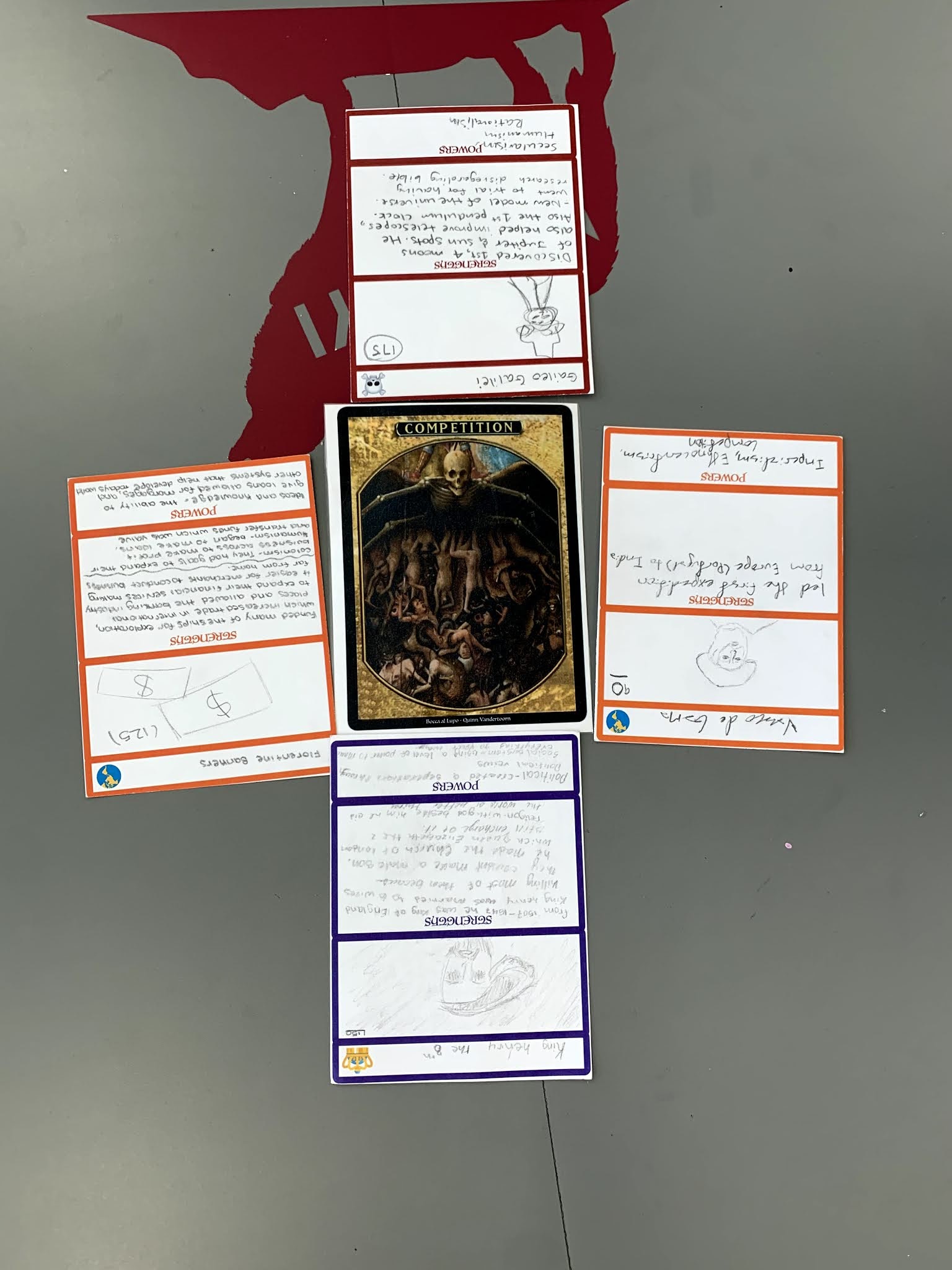
As they complete each level of the project in preparation for gameplay, the students create a card with a different Sosantivo. On the card, they draw a sketch of the Sosantivo, identify strengths, and make connections to Powers to which the Sosantivo relates. They complete seven levels, each one focused on a different aspect of the Renaissance: Arts & Culture, Math & Science, Religion, Trade & Travel, Politics, Technology & Innovations, and Philosophy. The student works through some research to learn about the Sosantivo, its role during the Renaissance, and use inferential and critical thinking to connect it to the Powers.
After the seventh level, the group has a full deck of cards and they're ready to play! Gameplay begins with the random drawing of a Power card, which is placed in the middle of the table. Then, each team randomly draws five cards from their full deck. To play the game, the team must play their cards, making connections to the Power Card or to other cards that have already been played. If they cannot play, they must draw another card from their deck. The object of the game is to be the first team to play all their cards.

Students will be more successful in the game if they have a good understanding of the connections between Powers and Sosantivo. Because each student focuses on completing a singular card during each level, collaboration is essential for success in the game. The more the students on the team collaborate with one another to learn about each Sosantivo and deeply understand the connections between then, the better they will do in the game.
One of the key principles we kept front and centre during the design of this game was that students should have multiple opportunities to demonstrate a skill, and feedback should help them move their learning forward. We made another change this year to how end-of-level assessment worked. Whereas in the past. assessment took place in a group discussion, where we talk about the Sosantivos, their connections, and the big picture ideas they are noticing during the level, this year we shifted this to a simulated round of gameplay with the group. We chose a Power Card or two and played a sample round, where each student played a card and connected it to the concept or another card. As we progressed, we added a challenge of them having to play a card they did not create.
An iteration we made in 2020-2021 was to give each student a feedback tracking sheet, which they kept in front of them during these assessment conversations and gave them a place to record feedback. We were very explicit in these conversations about what specific changes they could make in the next level to improve their progression towards our standards. We noticed that this feedback tracking sheet really helped students know what they needed to do to improve. Most students were hitting all the standards by the end of the seven levels.
We're happy to share our resources with you. Use them as-is, or hack them. If you do, we'd love to hear how it goes! E-mail us to let us know: elquinn@cbe.ab.ca and tabroshvandertoorn@cbe.ab.ca.
Here are links to Google Drive files with all the necessary files. If you'd rather just go to the whole folder, here's the link.
- A slidedeck to guide the game creation process
- An instruction manual to play the game
- A flowchart that shows the process of a level
- Player One Ready, the notecatcher students complete during research, as well as a modified version for students who need more structure/guidance.
- The Levels folder, with handouts for the research pages to help them complete the Player One Ready sheet.
- Levelling Up, a notecatcher for the students as they prepare for their end-of-level conference
- Powers Sheet, to help students keep track of each of the Powers and their definitions
- Minilessons on the Powers.
- Assessment Classlist, for the teacher to use during assessment of each level
- Feedback Tracking Sheet, for students to use to collect and track feedback to move their learning forward
- Links to folders with all the cards in Photoshop file format:
- Student Cards, which are the cards to play the game
- Power Cards, which are used to begin the game
- Boost Cards, which are awarded to the group at the end of each level based on their collective ability to make strong connections
- Judgment Day Cards, which are awarded when a player challenges another player during the game, where students can object to a weak connection. A mini debate is then had, which the Questmaster (teacher) judges and awards a card based on the strength of the argument
- Quest Cards: If a student completes their research before other member of their team are ready, they can complete a Quest - a short challenge that extends and deepens their understanding. The reward is a Quest Card, which is a valuable card that can be used in gameplay.


 Erin Quinn


