Image Slider

Showing posts with label Assessment. Show all posts
Wednesday, July 14, 2021

Redesigned Bocca al Lupo: A Game to Learn about the European Renaissance

Updated Summer of 2022

As a part of our regular practice, my teaching partner Tara and I systematically reflect on our practice. This reflection practice holds us accountable: to our students, to best practices in task design and assessment, and to ourselves.

We designed Bocca al Lupo in 2019 (click here to view a previous post about this game). Bocca al Lupo is a card game that we co-design with our students. It was initially designed as a card game that was a kind of mashup between Pokemon and War. We thought what we designed was pretty good. In essence, the students participated in "levels" where they chose a Sosantivo (Italian for "noun" - so a person, place, thing, or idea) of several possibilities and then created a card highlighting this Sosantivo's strengths and weaknesses. The students learned so much about the different ideas that emerged from the European Renaissance. They were also super engaged in the process. In our reflection practice, though, we realized that though they learned a lot, what was lacking was the big picture view of the changes that emerged during the Renaissance, and were missing the connections to broader ideas and trends that are so significant to our modern Western worldview. 


With social studies, we always want our students to come away with a bigger picture idea. Why do we learn about history? Learning about historical significance helps us understand why some ideas become so important to a culture's worldview while other ideas don't. In thinking critically about historical significance, we can look at our society now and understand why we behave in the way we do, and trace these roots to ideas that shaped our past. The study of the Renaissance is really about looking at the origins of a Western worldview - a worldview we can recognize here in North America today. 


So, we redesigned the game. Because we wanted this to be about making connections between ideas, we swapped the Pokemon/War game mechanic for another one: dominoes. The game of dominoes is all about making connections. This is a perfect example of why game-like learning fits in teaching and learning. We can use analogous concepts from games to help us reach our educational goals. For Tara and I, game-like learning isn't about gamifying - associating extrinsic rewards like points or avatars to traditional learning tasks. It's about borrowing concepts from games to design tasks around, leading to learning experiences that are intrinsically motivating and fun


The redesign is centred around the concept of "Powers." These are big ideas that emerged from the Renaissance or were a significant idea during the Renaissance that endure in some way today. The Powers we decided to centre on this year were: Competition, Democracy, Ethnocentrism, Feudalism, Hierarchy, Humanism, Imperialism/Colonialism, Monarchy, Monotheism, Oligarchy, Rationalism, Republic, Secularism, and Urbanization. We don't think we've quite hit on the perfect combination of Powers yet. Some worked better than others, which is kind of the point in that it makes the game more challenging as some concepts are more difficult to connect to. But others are hovering close to an idea that would be more appropriate, we think. 


In the 2021-2022 school year, we added minilessons to teach about these Power concepts. We taught one minilesson per day for the first seven days of the project. 
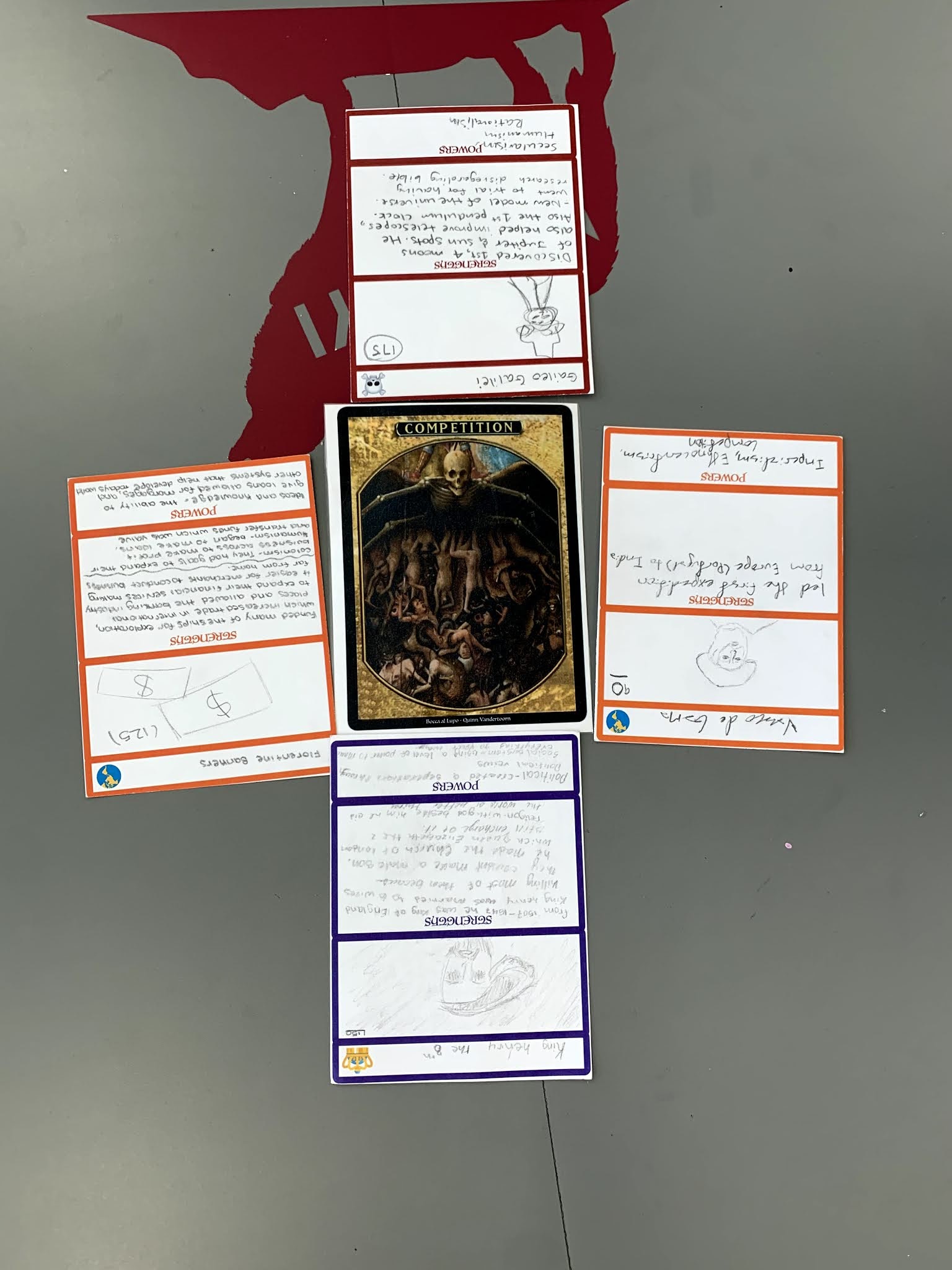

As they complete each level of the project in preparation for gameplay, the students create a card with a different Sosantivo. On the card, they draw a sketch of the Sosantivo, identify strengths, and make connections to Powers to which the Sosantivo relates. They complete seven levels, each one focused on a different aspect of the Renaissance: Arts & Culture, Math & Science, Religion, Trade & Travel, Politics, Technology & Innovations, and Philosophy. The student works through some research to learn about the Sosantivo, its role during the Renaissance, and use inferential and critical thinking to connect it to the Powers.

After the seventh level, the group has a full deck of cards and they're ready to play! Gameplay begins with the random drawing of a Power card, which is placed in the middle of the table. Then, each team randomly draws five cards from their full deck. To play the game, the team must play their cards, making connections to the Power Card or to other cards that have already been played. If they cannot play, they must draw another card from their deck. The object of the game is to be the first team to play all their cards. 


Students will be more successful in the game if they have a good understanding of the connections between Powers and Sosantivo. Because each student focuses on completing a singular card during each level, collaboration is essential for success in the game. The more the students on the team collaborate with one another to learn about each Sosantivo and deeply understand the connections between then, the better they will do in the game.


One of the key principles we kept front and centre during the design of this game was that students should have multiple opportunities to demonstrate a skill, and feedback should help them move their learning forward. We made another change this year to how end-of-level assessment worked. Whereas in the past. assessment took place in a group discussion, where we talk about the Sosantivos, their connections, and the big picture ideas they are noticing during the level, this year we shifted this to a simulated round of gameplay with the group. We chose a Power Card or two and played a sample round, where each student played a card and connected it to the concept or another card. As we progressed, we added a challenge of them having to play a card they did not create.

An iteration we made in 2020-2021 was to give each student a feedback tracking sheet, which they kept in front of them during these assessment conversations and gave them a place to record feedback. We were very explicit in these conversations about what specific changes they could make in the next level to improve their progression towards our standards. We noticed that this feedback tracking sheet really helped students know what they needed to do to improve. Most students were hitting all the standards by the end of the seven levels.


We're happy to share our resources with you. Use them as-is, or hack them. If you do, we'd love to hear how it goes! E-mail us to let us know: elquinn@cbe.ab.ca and tabroshvandertoorn@cbe.ab.ca.

Here are links to Google Drive files with all the necessary files. If you'd rather just go to the whole folder, here's the link.

  • A slidedeck to guide the game creation process
  • An instruction manual to play the game
  • A flowchart that shows the process of a level
  • Player One Ready, the notecatcher students complete during research, as well as a modified version for students who need more structure/guidance.
  • The Levels folder, with handouts for the research pages to help them complete the Player One Ready sheet.
  • Levelling Up, a notecatcher for the students as they prepare for their end-of-level conference
  • Powers Sheet, to help students keep track of each of the Powers and their definitions
  • Minilessons on the Powers.
  • Assessment Classlist, for the teacher to use during assessment of each level
  • Feedback Tracking Sheet, for students to use to collect and track feedback to move their learning forward
  • Links to folders with all the cards in Photoshop file format: 
    • Student Cards, which are the cards to play the game
    • Power Cards, which are used to begin the game
    • Boost Cards, which are awarded to the group at the end of each level based on their collective ability to make strong connections
    • Judgment Day Cards, which are awarded when a player challenges another player during the game, where students can object to a weak connection. A mini debate is then had, which the Questmaster (teacher) judges and awards a card based on the strength of the argument
    • Quest Cards: If a student completes their research before other member of their team are ready, they can complete a Quest - a short challenge that extends and deepens their understanding. The reward is a Quest Card, which is a valuable card that can be used in gameplay.
Please reach out if you have any questions or to share your ideas with us! The whole point of this post is to explore how reflection helps us iterate to be better, so we welcome your ideas to help us do that!

Connect with us on Twitter: Erin & Tara

Monday, December 21, 2020

Nihon no Okami: A Game to Teach about Japanese History and Worldviews

I have previously posted about a game we found to teach about Japanese history called Warlords of Japan. In grade 8 social studies in Alberta, our curriculum focuses on worldviews and the things that shape them and change them. We do a case study about Japan, focusing on the Edo and Meiji periods to learn about a period of government-imposed isolation and then the subsequent adaptation and modernization sparked by the Americans' forceful demand to Japan's leaders to open their borders to trade.


Warlords was fun, but it was created in the 1990s and its pedagogies aren't current. It also misses big parts of our curricular outcomes, only focusing on the feudal period before isolation. My teaching partner Tara and I decided that we needed to design something more rooted in current best practices in teaching and learning and game-based learning specifically, and more aligned with our curriculum.


We created a game called Nihon no Okami, or Okami for short, which translates to 'Wolves of Japan' (our school's team name is the Grey Wolves, and we often name our games in accordance with that). The game is very loosely based on Warlords of Japan, and shares the area of control Risk-like gameplay elements and the idea of the map with that game. Mostly everything else has been redesigned.


In Okami, students work in groups called goningumi, each of which is assigned a home shiro (castle). The goal of the game is to gain the most territory, develop the best local economy, with the happiest people. This works out to gaining territory in the game, as well as making economic and social improvements to their home shiro. The whole game (which was the entirety of our case study about Japan as it addresses all outcomes in the Program of Studies) takes eight weeks to play. The game changes as the weeks progress, representing the different periods in history: pre-isolation, isolation, civil war, adaptation, and modernization.

The gameboard for Nihon no Okami

Tara and I are open source teachers and want to share this game with anyone who can use it. We have developed a teachers' guide, which will give you the information you need to recreate this game in your classroom, along with links to all resources and handouts. We want you to hack it and make it work in your setting. Our request is simply that you share back what you do so we can learn from you, too. You can find our e-mails in the teachers' guide, or you can comment on this post to share back.

Jars of Koku (a unit of measurement of rice, the currency of Edo Japan) and the currency in Okami

We use principles of game-based learning borrowed from the now-defunct Institute of Play to design all our Social Studies projects:

  1. Everyone is a participant
  2. Failure is reframed as an iteration
  3. Everything is interconnected
  4. Learning happens by doing
  5. Feedback is immediate and ongoing
  6. Challenge is constant
  7. Learning feels like play
When using game-based learning in the classroom, two outcomes are important. Firstly, it's important that the game is fun and the students feel invested in the game and in their learning. Secondly, and more importantly, it's important that they learn. We know from research about effective teaching that students must find the work they do intellectually engaging, and "fun activities" don't really cut it. We believe we have created a careful balance here to position the learning in this game as knowledge they need for gameplay, and by connecting this with games, we have deeply connected the learning of history to something that's important in the worlds in which our students live.

In terms of these outcomes, we believe our design has been successful. Our students loved playing this game, and were visibly and audibly engaged in both the game and the learning required by it. We also believe our students have learned a lot. We outline assessment practices in the teachers' guide, and most of our students were demonstrating high levels of achievement through the iterative assessment practices this game involves. 


Two students strategizing

A final note about the competencies games develop. When we play games, we learn skills that are important in school and in life. We learn collaboration, cooperation, sportsmanship, patience, strategy, long-term thinking, if-then thinking, among others. We get opportunities to coach our students on character, citizenship, and personal development. We see our students' humanity shine through. And that's got to be worth something.
Thursday, March 19, 2020

Room to Breathe (R2B): Personalizing the Language Arts through Student-Designed Projects

This post was updated in February 2021.

The Origin Story

My teaching partner Tara and I knew we needed to redesign the way we taught Language Arts to our grade 8 students this year. What we had been doing was okay, and we did some pretty neat things with our kids, but it certainly wasn't streamlined, and engagement was pretty variable, depending on the task. So we went away in the summer with lots of things to think about, good books to read, and ideas to percolate.

When we met over coffee in August, we came to the conclusion that we wanted to do a reading/writing workshop-style approach. In this initial conversation, we wondered about how we would teach the other strands that are a part of our curriculum: listening, speaking, viewing, and representing. We thought maybe we could do something with these on Fridays. I was just pulling out of the parking lot when Tara called me on handsfree saying, "Wait a minute. WHY would we only do these strands on Fridays?? Why not all the time?"

This is how Room to Breathe was born.

R2B In a Nutshell

Students self-design projects that include an Inhale (Reading, Listening, Viewing) - in other words, text interpretation - and an Exhale (Writing, Speaking, Representing) - in other words, text creation. When they design their projects, they associate "I Can" statements - our entire curriculum reworded in kid-friendly language. Students conference with their teacher before they begin, and again at the end of each Inhale and Exhale. This allows us to help set students up for success when they start, to identify skills that need to be taught, and what resources will be needed. It also allows us to collaboratively assess the student work with the students (more on that later!).

Room to Breathe is the bulk of our English Language Arts instruction time. In 2019-2020, we had time for two full rounds of R2B (that's six projects), a class novel, and a final project. The way Room to Breathe is designed, students achieve all the outcomes from the curriculum over the course of the year (sometimes many times over!).

If you'd prefer to see us explain it to you, we recorded a presentation that we presented at the Calgary City Teachers Convention, in which we share the logistics, practical considerations, and philosophy of our Room to Breathe approach.

The Logistics

We created a flowchart for the Room to Breathe processes to help students get the hang of it, at first. Once they get used to the process, they don't need to refer to the flowchart - it becomes a part of their muscle memory.


Students use a planning sheet to organize their idea before we conference. The planning sheet includes the "I Can" statements, as well as a spot for the student, teacher, and parent to sign when approved.


A selection of some of our "I Can" Statements

The very first set of conferences to get the first Inhale approved is fast and furious, but then meetings are spaced out. We learned that finding a way to stagger that first set of conferences is the way to go, and often have an assignment the students are working on prior. This year, we did a practice inhale-exhale with a shared article and some poems to practice together how to annotate a text during an Inhale, and then had the students write an Exhale their own in the style of one of the mentor texts. Students then signed up for a conference when they completed this initial assignment, spreading out the first round of conferences.

Students set their own due date for the completion of their task and write their name on our classroom calendar on the due date. That becomes their next conference date. As we progressed through the year, we found ways to streamline this. In the classroom, we used a big calendar on the whiteboard for students to write their due date on, which informed us of our conference schedule for the day. Students knew there could be a maximum of four conferences scheduled each day. During emergency online learning during the COVID lockdown, we used a Google Calendar with bookable appointment slots to scheduled one-on-one conferences.

We offer minilessons based on student needs and questions that we compile as we conference prior to beginning a task. Here is a slidedeck we are continually adding to based on our minilessons. These minilessons come organically from what the students need. Not all students are required to attend a minilesson, only those who the minilesson applies to. Why learn about how to analyze a song if you're working on creating a stop motion video? Sometimes this means we repeat minilessons throughout the year, and that's okay. This is about meeting the students' needs and helping them grow.

The Principles

Now that we've gotten the "what" out of the way, we want to dig in a bit deeper into the "why."

A few principles guide our work and have been designed to be heart and centre in R2B.

For student learning to be truly personalised, they need to be the ones making decisions about what to read, view, create, and share.

We have heard people bemoaning the idea that today's youth don't read and write anymore. This is simply not true. In fact, students are reading and write more than ever before using social media and other platforms. In addition to all this reading and writing, they are engaging in sophisticated forms of content creation through platforms like YouTube, Instagram, and Tik Tok. The problem is that this kind of text interpretation and creation is sometimes not acknowledged or honoured in classrooms. Of course, we want our students to interpret and create in more critical and analytical ways. But by using the topics and ideas they already care about and allowing them to design their own tasks around these interests, student learning will be incredibly personalized and rich.

We were very inspired by the incredible book Beyond Literary Analysis as we designed R2B and their website Moving Writers has been instrumental as well. In both resources, Allison Marchetti and Rebekah O’Dell offer real strategies and methods for using topics that captivate our students and design tasks around them.

Assessment is teaching.

Most of the most powerful work in R2B happens during conference times. We have a chance to sit, one-on-one, with our students and really talk about their learning. When we look at the work that they completed and talk about what they are proud of, and what their next steps are, they get immediate, actionable feedback about what to focus on next. Because this project is ongoing, the feedback they receive is immediately implementable. 

Guess what this means? We don't take grading home. It means being intensely present during the one hour we work on R2B each day, but then our planning periods and after school time can be used to plan for student learning and respond to their needs.

Assessment happens here, not alone, on my couch.


We collaboratively assess and grade all work in R2B with our students, during conferences. In these assessment conversations, and following a conversation about what they learned and demonstrated in their work, we ask our students to suggest a grade for their work. In 99.9% of situations, students' perceptions of their own work are in line with our perceptions. We assess against the "I Can" statements the students selected, and if they can provide lots of evidence to show how they met the outcomes, there is no reason why they shouldn't receive a 4 (our school board uses a 1-4 indicator scale for assessment and reporting). 

The conversation, however, has quickly shifted from one of evaluation and judgment to one of learning - how can we, together, help you improve the complexity of your thinking and learning? We had mentioned that we wanted to push our students into analytical and critical thinking, and to support our students, we created a continuum of thinking:


This document has proven very useful for assessment conversations because if they aren't finding themselves using analytical, evaluative, and creative thinking, they are not demonstrating mastery. It also helps the students when they're designing a task. If they propose they're going to watch the movie Mean Girls and then summarize the story, this isn't designed in such a way that they can access analytical thinking. In our conference, we'll help the students redesign this proposal so it takes a more critical stance. In that example, it might become "I'm going to watch the movie Mean Girls, and identify the character archetypes present. Then I'm going to create a short film using character archetypes to help build meaning." Or it might become, "I'm going to analyze the movie Mean Girls, and then write a review about the movie, answering the question 'Does this 2004 film hold up in 2020 in how it portrays teenagers?"."

Student choice and ownership leads to authentic text interpretation and creation.

The proof in this approach has been the incredible engagement of our students. Our students can't wait for the hour in their day when they can truly breathe and focus on something that they have designed to explicitly engage themselves in their own learning. We have had an incredible range of student projects, which you can check out on our blog.

A Special Note About COVID-19 and Online Teaching and Learning

Many of us have found ourselves in situations where we need to be designing work that students can complete at home and submit online. As we learned about schools being closed indefinitely in our province, we breathed a sigh of relief because R2B could continue, business as usual. 

We continued R2B with our students during emergency online learning. Students used Google Drive to work on their projects, as they had done while at school. As mentioned, we moved all conferences to Google Meet, which students signed up for using Google Calendar. For those teachers who are finding themselves in interesting teaching scenarios, be that full online learning, a hybrid approach, or in the physical school with health precautions, Room to Breathe will work for you.

Resources:

Please borrow any of our resources if they are helpful to you. Make a copy. Hack them. Make them yours. And then tell us about it! Tweet at us: @luckybydesign (Erin) and @bestcircus (Tara).

Get in Touch

If any of these resources are useful to you, you've been inspired by our approach, or have any questions for us, please reach out to us! You can find us on Twitter at @luckybydesign (Erin) and @bestcircus (Tara), or you can e-mail the Creativity Collective at thecreativitycollective@gmail.com

Tuesday, July 30, 2019

Boca al Lupo: A Game to Learn Historical Significance and the Renaissance

Boca al Lupo
Italian, "from the mouth of the wolf"
An expression, often used in theatre, to wish someone good luck.

When it came time for us to begin our first major case study about worldviews, a look at how ideas spread during the Italian Renaissance, and how a Western worldview emerged, we were totally stuck. We looked at things other people had created, and projects we'd done in the past. One huge problem with this interesting, yet very history-focused curriculum, is that many teachers tend to focus on content (what happened) rather than phenomena and significance (why it matters).

We knew we wanted to focus on the latter. We had a couple of frustrating planning meetings with our Humanities team, which consisted of my incredible team partner Tara, and my student teacher Adrienne. Finally, a conversation that took the form of plussing happened - where we took an attitude of "yes, and" and added on to another person's idea. We were talking about games and principles of game-like learning, and the seed of Boca al Lupo was born. Boca al Lupo is essentially a smashup of Pokemon cards and War.

Here's the premise of Boca al Lupo:

  • Students are organized into teams of 5-6 people, called Guilds. The students give the guild a name, a motto, and a coat of arms (after a little minilesson on European heraldry).
  • There are seven Levels in the game creation. Each Guild works on one level at a time, in whichever order they want. The levels are: Arts/Culture, Math/Science/Health, Philosophy, Political Systems, Religion, Technology, and Trade/Commerce/Competition. We created a package for each level, in which we found grade-level information about topics and people of significance in that area during the Italian Renaissance. For example, in Arts/Culture, we featured Christine de Pizan, Humanism, Leonardo da Vinci, Michelangelo Buanarotti, The House of Medici Patronage, and William Shakepeare.
  • The students worked through each level with their Guild. Each member of the Guild was responsible for creating one card for their deck of Boca al Lupo cards. They each chose one of the people or topics from the level to research and create a card for. They used a graphic organizer called Player One Ready to organize their research. We had a complex version and one that was a bit simplified for our students who needed it. We also had a sheet called Leveling Up! which I'll talk about in a minute. We borrowed many of the concepts on the Ready Player One sheets from the Historical Thinking Project. Here's the sheets:

  • After each student was finished their Ready Player One sheet, the group would get together to complete the Levelling Up sheet together. They would share what they learned about their own person or topic with the group, and then assess the level of historical significance together, creating a kind of ranking of the topics or people in terms of how historically significant they were. The group would have 200 Health Points (HP) and Damage Points (DP) to divvy up when they got to their hard creation, and this ranking would help them do this. It also ensured that people in the group were familiar with all the topics in the level. We wouldn't want someone, for example, not knowing what humanism was all about because they'd researched William Shakespeare.
  • After this point, the group would call their Questmaster (which is what the teachers were called during the game. I wore a cape. It was amazing) over for an interview. We used an assessment sheet to keep track of how each student was doing during the level.

I want to break here to talk about assessment for a moment. One of the principles of game-like learning is "Feedback is immediate and ongoing." Feedback is one of the reasons why playing games is fun. You get instant and continuous feedback about how you're doing. We wanted to make sure this was part of the way this project worked, so we developed the interview. This made sure that groups were getting feedback before they went to create their cards. It gave us time to check for understanding from each student. We talked to the group about what they'd learned about, and made sure they knew the historical significance. It gave us a feedback loop in case the students had missed something pretty important. If they thought humanism wasn't particularly historically significant, we could give them some feedback about what else they needed to read or research to get a more complete understanding of the topic. We did one interview per group per level.

This meant seven opportunities to check in on the learning for each student. This meant seven chances for a kid to show their progress on each stem (we use our report card stems in a very similar way to how you'd see standards or objectives used in standard-based grading and objective-based assessment). The content would be different for each attempt, but the skills are the same. We were looking for growth for each student over time, and kept a master record of each student for each level as we did the interview. I used Checkmark, Checkmark Minus, and Checkmark Plus symbols to note which students had strong understanding and more tenuous understanding for each skill. If a student did not meet the objective at a basic level, he/she was given feedback and asked to continue working on their research and then we'd have a follow up interview to check for understanding again. As a result, no students were working below grade level on this project.
  • When the interview was complete, and all students had at least a basic understanding of the objectives, students were given two things: a boost card (worth 2x, 3x, or 4x the Health Points) based on how well the whole group understood their topics, and blank card templates.
This is where the 200 HP and DP come in again. The group had 200 to distribute amongst the group's cards. They could decide as a group how to do that, but they had to be able to justify their allocation. They gave each person or topic two strengths and a weakness. For example, a strength of the Black Death might be "Kills 2/3s of all human cards" or "Kills nobility and peasants equally. Roll a dice. If you roll less than 3, your card is automatically killed." A weakness could be "Demolishes the feudal system. All lower class cards increase their HP by 30." They combine their knowledge of the historical event or person, and bring in elements of gameplay to have the card influence the play. In the box at the top, they'd also draw a picture.


  • At any point in the level, if they finished their job earlier than the rest of their guild members, they had an opportunity to do a side quest. Side quests were an extra task for them to do, adding an element of enrichment for those who needed it. Quests would be things like, "Learn the meaning and context of 5 Shakespearean insults and then write one of your own, to be used during game play" or "Research one-point linear perspective then use it to create a drawing of a hallway or room in the school." Quests would give the group a bonus card that would benefit them during gameplay. The quest cards were made by Tara using a website called MTG Cardsmith!


  • Once all the cards were created, then the group could move on to the next level, and start the process all over again.

Once all groups had progressed through all seven levels, then they had a deck of cards that they would play the game with. Gameplay looked like this: We created a double elimination tournament bracket so each group would play at least twice. They would put five cards down on the table as their "bench," which is how Pokemon works. Then they'd turn the cards over in that order. Whatever was written as the strengths and weaknesses was applied. If neither card was eliminated, it went down to HP and DP to determine the winner. The winning team kept both cards, and could use them in future gameplay. Sometimes, there were disputes about a card having an unreasonable amount of power for its historical significance. At that point, they called a Questmaster over to hear the arguments and make a decision. This turned out to be a great chance for students to use persuasive skills and logic to present an argument. 


The final game came down to these two cards: Humanism vs. the Printing Press. We had to call it a tie.

As always, we have some changes we'd make next time. Most importantly, we need to figure out a better way to differentiate for students who have unique learning needs. Though we did create modified versions of the graphic organizers, students who needed modified work struggled with this task more than they should. All students should have pathways to excellence, and if a student didn't do a great job on their card, the card wouldn't be very useful to the group. We need to create a pathway to excellence for all students in this game. We don't yet have an idea for how to do this, but it's a definite redesign next time.

We'd also do a trial game early into the process, maybe after two levels, so the students can see how the gameplay works, which will give them feedback about how to improve their cards. We were kind of figuring this out as we were going through it so we didn't do this, but this would be an easy thing to incorporate next time.

Overall, we were happy to know that each student understood factors that shaped the Renaissance and the emergence of a Western worldview and were successfully able to employ historical thinking to determine historical significance.

The two Questmasters, debating a challenge

Resources Shared:

Thursday, October 02, 2014

Linking Art and Math

by Stephanie Bartlett
Lately I have noticed that my bulletin boards don't look very traditional. In fact, if you took a quick glance expecting a display of uniform work, you will be disappointed.
I am wildly proud of my students' work, but feel that I need to explain the process so that people can appreciate how they arrived at the finished product. It started as an art project, extending over a couple of weeks when it fit into our learning. We learned about warm colours one week and experimented with colour and paints. Next, we learned about cool colours and did the same. Throughout this process, we talked about how to  use the water colour paints, how to wash the brushes and the fact that students were free to paint around the room but needed to be responsible and clean up. 

The next time we pulled out the projects, students were given their samples of warm colours and cool colours. Choosing one as the background, they cut the other into rectangles and glued them on as trees. Branches and details in the bark were added on as the finishing touches with a coveted Sharpie marker. 
I could have stopped at that point and put them on the wall but my goal is to teach the students to recognize math in the world around us wherever possible. I distributed the paintings, and scattered counters in the centre of the circle. Students were invited to put a counter on each tree, then write the number on a sticky note, then find where best to display their work on the whiteboard. 

The opportunities to assess this task are many, encompassing fine motor skills, one-to-one correspondence, ability to print numbers, follow directions, and the list goes on. Some students even extended their understanding by drawing another representation of the same number on the sticky note. I documented by taking pictures, recording conversations and making notes for next steps. 

Students were highly engaged in a rich, meaningful task at the end of the day in Kindergarten and I had to stop them to clean up and go home. That speaks volumes to me. 
Tuesday, March 25, 2014

Looking Closely at Student-Owned Documentation

by Stephanie Bartlett

A big part of my journey this year has been exploring documentation panels.  Inspired by the many talented educators on twitter, I have read, thought, researched, reflected...and the cycle repeats.  I take photos and videos and must admit that I am still figuring out a process to post the photos in the classroom in a timely manner.  (I would appreciate any techniques from those well versed in the world of documentation panels.)
The other day, I printed the photos of our coconut explorations. I thought that if Hunter cut out the pictures, and we explained them together, then the panel would be meaningful to him rather than the parents coming for conferences as had been my original intention. He got some fine motor and sequencing practice cutting and ordering the pictures before we got ready to document the story.
I settled in with sticky notes and proceeded to be amazed at what I learned from Hunter. I thought he would label each event in each picture.  Instead, Hunter labelled the steps of collaboration. The first step was Hunter finding the coconut and exploring on his own. The second group of pictures was when Erik came to join him, the third was the class (spelled phonetically KSE) and the fourth was the opening of the coconut. 
Together we reflected on the different questions that he had been asking and I scribed those underneath.  The message had come through loud and clear for me and I was thrilled: collaborative development is an integral part of creativity in educational practice.  Hunter showed me in his own words that collaboration has been embedded in our classroom culture.
There is an important place for teacher-directed documentation panels to explain our programs to adults, and to celebrate the learning of our students by showing the thinking process.  Dylan William states in his book  Embedded Formative Assessment that "teachers have a crucial role to play in designing situations in which learning takes place, but only learners create learning." (William 158)  I provided the learning provocation and then the pictures; Hunter responded with a high level of engagement and showed me how students can help manage their learning process.  It is now up to me to take everything Hunter shared with me to help design new learning experiences for him and the class. 

Citation:

William, Dylan (2011.) Embedded Formative Assessment. Bloomington, IN: Solution Tree Press
Monday, March 03, 2014

Blow, Blow, Blow Your Boat

by Stephanie Bartlett
A play-based program is the ultimate backdrop for the most incredible learning opportunities.  It is our job as educators to pay attention and listen carefully. As facilitators, we  can then offer tools and experiences for students to become mindful learners, all in the midst of play.  Take boats, for example.
Over the course of the last couple of months, B, H and C have often sat and drawn pictures of boats.  We have hung them on the wall near our water table and I have waited for the right moment to take their learning to a deeper level.  It all came together this week when many students were involved in a pirate game.  They created treasures to hide and drew maps for everyone to take part. (Hello, collaboration!!) For two days, I watched and listened carefully, wondering how to decide the best way to guide their thinking. I asked my three students to sit the next day and draw plans for boats they could build.  Their plans initiated a class discussion about motor boats and sail boats, and pirate ships, of course!

 B went to the next step and created a materials list.


The next day, B arrived and spent a large amount of time building a model boat out of popsicle sticks, telling me "I thought and thought at home about how I could build a boat with buttons, popsicle sticks and string. This boat collects garbage on the ocean and I need to build a claw on the back."


Coincidentally, my colleague mentioned earlier in the week that she had many students who were very taken with machines, motors and boats in particular.  There was my point of convergence. We could create boats together!  As a team, we have decided to offer the opportunity to students in all three of our kindergarten classes to work together. Today, we had two parent volunteers come in and set up an area with materials, paper and writing tools to draw plans and a tub of water to test for seaworthiness. Knowing that sparks catch fire, we started this idea with the interest of a few students, knowing that others would jump on board, so to speak. The environment was focused and highly engaged. There was a quiet hum of happiness and excitement, peppered with observations, in the most natural form of analytic thinking and feedback.  

"I think your boat is leaning too far to one side." 
"How can I get my boat to move?" 
"You need some wind. Can you blow?"
"Mine is sinking." 
"My boat is heavy on one side. It keeps leaning."

Some students drew plans and then proceeded to build without referring to their plan.  There is an interesting focus point for the next projects, always keeping in mind that some learners are unable at this point to articulate what their plan is before they execute and we believe that is ok.


Others, drew their plans and build their boats accordingly.


Genius Hour has been very fluid in my class this year.  My original intent was to spend every Friday morning engaged in different projects.  In the ever-changing world of Kindergarten, if students are protopying an idea or developing an idea, they are not all going to put it away until the following week...they will keep playing until they are ready to discover new things or play with different people.  So, on Fridays when I have two parent volunteers, I now create the space and provide the materials for students who are experimenting with certain ideas. 
As educators, we can help students discover new concepts and play with intention. Teaching without themes in the traditional sense of the word is perhaps best understood through the lens of creative development.  The vocabulary and disposition of creative development is the common thread that helps my students to open their minds and apply the skills we are learning in a very real context that is relevant to them.  
What's next? On Monday morning, when the students enter the room, their boats will be waiting for them.  Will they return to their boats and continue tweaking their models? Will others have decided that they would like to build another prototype? Will they play with their boats in the water table? Will some draw another picture or write a story? Will they naturally group the different types?


One thing is certain: I will be nearby, listening to the feedback and analytical development and watching the magic of engaged students, waiting for the next possible spark.
Saturday, February 22, 2014

Measuring One's Self

Written by Erin Quinn.
Watch this video, and listen to what the little girl is saying.

I am lucky enough to be taking a graduate cohort with Dr. David Jardine, an incredible scholar of hermeneutics, ecology, and pedagogy. In class the other night, Dr. Jardine was talking about measurement.
Measurement can be a dirty word in education. We cringe when we think about Provincial Achievement Test results, the Fraser Report, and merit pay for teachers based on student results. Dr. Jardine's point, though, was that we need to allow for some space around the word "measurement," or "testing." Dr. Jardine suggested we treat the word "measurement" as the truest word we could possibly say. We should let measurement be as good as it can be.
The video of the ski jumper is about measurement. It's about testing. But it's one kid's self-initiated test against herself. She is testing her own limits. She is measuring up to her own courage and bravery.
How can we liberate kids to test themselves, to measure themselves, and to feel this kind of elation in the learning they do in our classrooms?
Monday, September 30, 2013

Curricular Obligations in the Creative Classroom

or How Do You Uncover 400 Years of History in 10 Months?

By Erin Quinn

One of the biggest struggles for a creative teacher is balancing the demands of packed curriculums with the desire to provide time and space for student creativity. I teach grade 7 Language Arts and Social Studies. Language Arts is no problem - it lends itself quite well to creative pursuits. But the grade 7 Social Studies curriculum is a beast of a curriculum. It focuses on pre- and post-Confederation Canadian history, basically spanning the years from 1600 to the mid 20th century. Pretty big for eleven-year-olds to swallow.

This past summer, I sorted the curriculum into Googleable and Non-Googleable outcomes, and discovered that the majority of the content objectives involved lower level thinking skills. Specific outcomes like, “What factors led to Louis Riel’s emergence as the leader of the Métis?” or “What was the role and intent of Chief Pontiac in controlling British forts?” could be handled in a classroom in a way that does not promote creative and critical thinking skills. Look it up in a textbook. Google it. Answer it on a multiple choice test. But it doesn’t have to be this way.

In jumping into this curriculum, my team teachers and I wanted to start with a project that would allow students to spend a bit of time on the context of the curriculum. Really, the crux of the curriculum, as with most history, is “Who are we and how did we get here?” Put in another way, “What changes have occurred in Canada over the past four centuries, and why? And how do these changes impact us?” So we wanted to focus on present-day Canada for a bit to take a look at where we are now.

The Game of Canada

We started with the idea of doing some centres focused on different aspects of Canada today, and concepts that would underlie students’ understanding of being able to understand what has changed from 1600 to present. This went through a few iterations, but then I stumbled upon Q Learning from the Institute of Play. I knew about gamification of learning before, but hadn’t tried it, and the design packs from Q Learning really helped me wrap my brain around it. In a nutshell, gamification is applying concepts from game mechanics to non-game situations. To be clear, it is not using games in learning - that’s a totally different thing altogether.

I had spent the first couple of weeks of school learning about who these kids were, and knew many of them considered themselves gamers. So, I gamified the project. Each centre was turned into a quest. Students would be working in Guilds, and would create an identity for their guild by making a coat of arms and a motto. They would work cooperatively to learn together.
Some of the coats of arms with the badges they earned.

Teaching Like a Pirate

And here’s something silly but something profound. In order to permit your students from taking risks in learning, you need to do it too. This was one of my main takeaways from the short, but infinitely inspiring book by Dave Burgess called Teach Like a Pirate. So guess what I did? Called myself the QuestMaster and donned a cape. Whenever we are working on the quests, I am wearing my cape. Let me tell you, I have gotten plenty of strange looks in the hallway. And a million people have asked, “Ms. Quinn, why are you wearing a cape?” to which I reply, “Why not?!” But who cares? I’m doing this to give my students permission to do it too. I’m laying the building blocks that will allow for creative risk taking as our year progresses.

Me as the QuestMaster.

Gamification of Assessment

It just so happens that this project aligned quite well with my school’s current shift towards outcome-based assessment. Some of the actual quests do not really require creative skills. Looking at the three types of creative learning designs, some of the quests would qualify as Type 1 activities: skill and knowledge acquisition, such as the map quest and reading a news article about a significant Canadian story. Some are Type 2 activities, like redesigning the Canadian flag to reflect its modern identity, and writing/filming/drawing the story of an explorer coming to Canada. Both these types of tasks are necessary. I think the beauty of these quests, though, lie in their assessment. I pulled curricular outcomes from the curricular document and translated them into kid friendly “I can statements.” For example, “I can examine different ideas and points of view expressed in a media message,” or “I can choose symbols that represent Canada and support my choices with research.”

The Genius of Angry Birds

When the guild thinks they are ready and have achieved the outcomes for the quest, they call me over and we have a look. We discuss the learning and notice where evidence of the outcome is. Through discussion, we come up with a number of stars out the possible three. This gamification concept may be familiar to you if you’ve ever played Angry Birds:


In Angry Birds, it is possible to pass a level if you get one star out of three. But you can also go back and replay the level to earn more stars. Likewise, with the quests, students can choose whether they’d like to continue working on a quest to improve it, or move on to the next one. What’s been really surprising for me to see is how many guilds opt to go back and try again. I’d say probably 80% of guilds who get less than three stars go back to improve it.

Mastery of Learning

This scenario probably sounds familiar to you: In the past when I was younger and greener, I would assign students a writing assignment, take it in, mark it, give it back, and give them the opportunity to improve it to hand in for a better mark. Maybe one or two kids would take me up on this offer. This is a good step on the right path towards encouraging mastery of learning, but the way these quests are assessed has been so much better. In reflection, I think there’s a few differences between the way the quests are assessed and the hypothetical redo of a writing assignment. First, the gamification aspect gives kids an entry point that is familiar and fun to them. Second, and I can’t stress this enough: conversation is the most powerful form of assessment. Through conversation, I have a clear idea who knows what they’re talking about and who doesn’t. I scribble as they talk and write down evidence of learning. For some guilds, we quickly run into our dead end. The assessment conversation sometimes ends up being quite short the first time because it is obvious that the students aren’t ready to be assessed yet. They go back and try again. Third, specific, clear feedback was given during these chats. I told (and wrote) the guilds exactly what they needed to still learn to earn more stars, and the feedback was immediate. They didn’t have to go home, read what I wrote, improve their essay or story on their own time, and take the time to hand it back in.

And the end result of this 80% re-attempt at learning? Mastery. Better learning. Persistence, grit. High levels of achievement across the whole class. Who wouldn’t want that?!

This type of assessment would lend itself extremely well to type 2 and 3 tasks as well. In fact, the last quest of the game is called Boss Level. The instructions are quite simple, “Create something to show your understanding of the Big Question: “What does it mean to be Canadian?” Students will use their learning from the quests to help them formulate an answer to this question and create something, anything, that shows their ideas about this question. We’re veering into Type 3 territory here, since students will need to apply the creative process in order to create something new and answer a significant, open ended question.

Creativity Breeds Creativity

So now we come back to the topic of this article: how does a teacher in a heavy-content area allow for creativity in the classroom? Maybe I’m oversimplifying here, but it really just involves being creative yourself. Looking at your curriculum with a creative eye will allow for a project like this one, one where kids have fun learning content as well as important creative and higher level thinking skills.

Downloads

Please feel free to download the assignment and assessment sheets.

The Game of Canada.pdf
The Game of Canada - Assessment