Image Slider

Showing posts with label gamelike learning. Show all posts
Wednesday, July 14, 2021

Redesigned Bocca al Lupo: A Game to Learn about the European Renaissance

Updated Summer of 2022

As a part of our regular practice, my teaching partner Tara and I systematically reflect on our practice. This reflection practice holds us accountable: to our students, to best practices in task design and assessment, and to ourselves.

We designed Bocca al Lupo in 2019 (click here to view a previous post about this game). Bocca al Lupo is a card game that we co-design with our students. It was initially designed as a card game that was a kind of mashup between Pokemon and War. We thought what we designed was pretty good. In essence, the students participated in "levels" where they chose a Sosantivo (Italian for "noun" - so a person, place, thing, or idea) of several possibilities and then created a card highlighting this Sosantivo's strengths and weaknesses. The students learned so much about the different ideas that emerged from the European Renaissance. They were also super engaged in the process. In our reflection practice, though, we realized that though they learned a lot, what was lacking was the big picture view of the changes that emerged during the Renaissance, and were missing the connections to broader ideas and trends that are so significant to our modern Western worldview. 


With social studies, we always want our students to come away with a bigger picture idea. Why do we learn about history? Learning about historical significance helps us understand why some ideas become so important to a culture's worldview while other ideas don't. In thinking critically about historical significance, we can look at our society now and understand why we behave in the way we do, and trace these roots to ideas that shaped our past. The study of the Renaissance is really about looking at the origins of a Western worldview - a worldview we can recognize here in North America today. 


So, we redesigned the game. Because we wanted this to be about making connections between ideas, we swapped the Pokemon/War game mechanic for another one: dominoes. The game of dominoes is all about making connections. This is a perfect example of why game-like learning fits in teaching and learning. We can use analogous concepts from games to help us reach our educational goals. For Tara and I, game-like learning isn't about gamifying - associating extrinsic rewards like points or avatars to traditional learning tasks. It's about borrowing concepts from games to design tasks around, leading to learning experiences that are intrinsically motivating and fun. 


The redesign is centred around the concept of "Powers." These are big ideas that emerged from the Renaissance or were a significant idea during the Renaissance that endure in some way today. The Powers we decided to centre on this year were: Competition, Democracy, Ethnocentrism, Feudalism, Hierarchy, Humanism, Imperialism/Colonialism, Monarchy, Monotheism, Oligarchy, Rationalism, Republic, Secularism, and Urbanization. We don't think we've quite hit on the perfect combination of Powers yet. Some worked better than others, which is kind of the point in that it makes the game more challenging as some concepts are more difficult to connect to. But others are hovering close to an idea that would be more appropriate, we think. 


In the 2021-2022 school year, we added minilessons to teach about these Power concepts. We taught one minilesson per day for the first seven days of the project. 
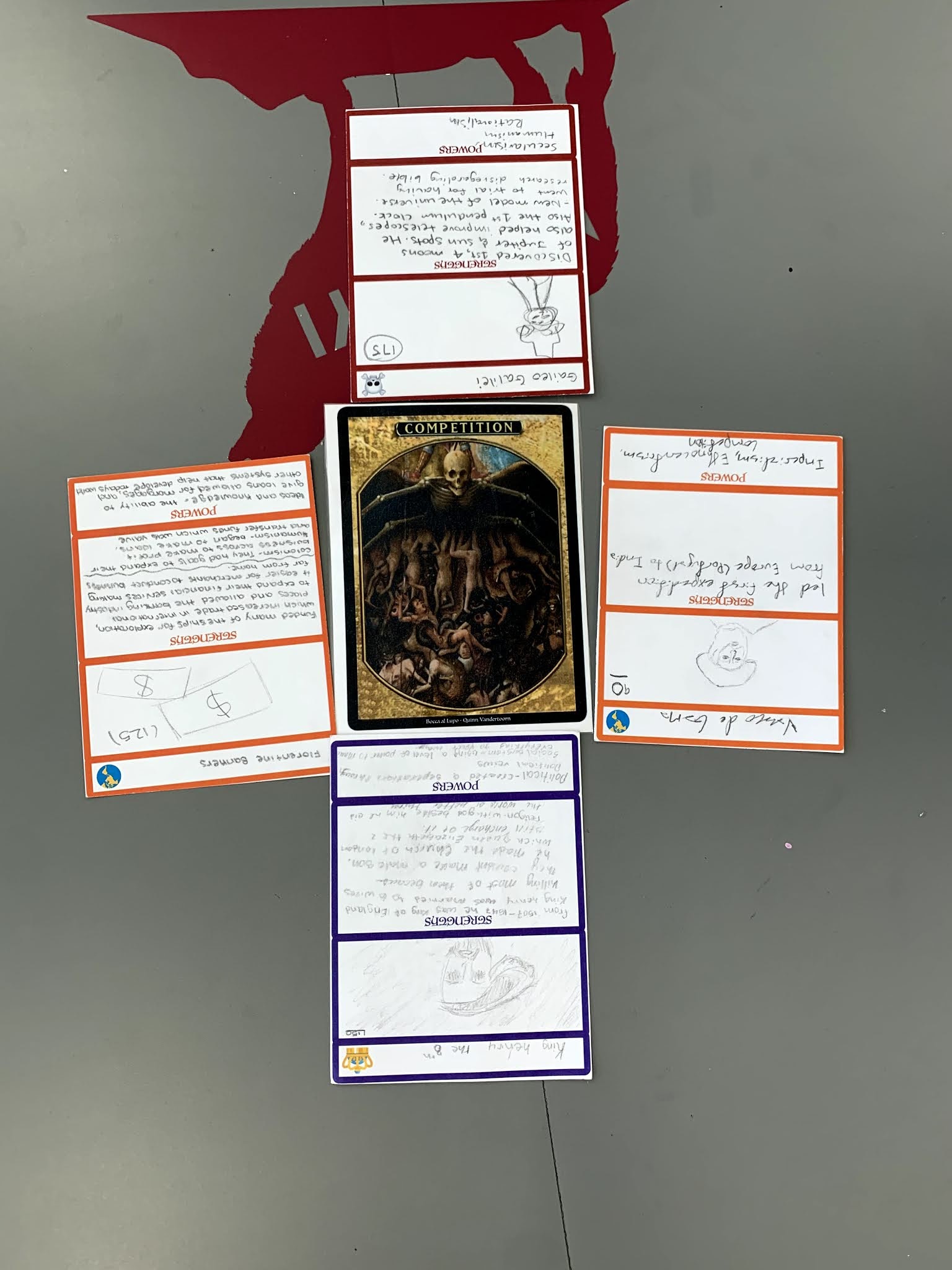

As they complete each level of the project in preparation for gameplay, the students create a card with a different Sosantivo. On the card, they draw a sketch of the Sosantivo, identify strengths, and make connections to Powers to which the Sosantivo relates. They complete seven levels, each one focused on a different aspect of the Renaissance: Arts & Culture, Math & Science, Religion, Trade & Travel, Politics, Technology & Innovations, and Philosophy. The student works through some research to learn about the Sosantivo, its role during the Renaissance, and use inferential and critical thinking to connect it to the Powers.

After the seventh level, the group has a full deck of cards and they're ready to play! Gameplay begins with the random drawing of a Power card, which is placed in the middle of the table. Then, each team randomly draws five cards from their full deck. To play the game, the team must play their cards, making connections to the Power Card or to other cards that have already been played. If they cannot play, they must draw another card from their deck. The object of the game is to be the first team to play all their cards. 


Students will be more successful in the game if they have a good understanding of the connections between Powers and Sosantivo. Because each student focuses on completing a singular card during each level, collaboration is essential for success in the game. The more the students on the team collaborate with one another to learn about each Sosantivo and deeply understand the connections between then, the better they will do in the game.


One of the key principles we kept front and centre during the design of this game was that students should have multiple opportunities to demonstrate a skill, and feedback should help them move their learning forward. We made another change this year to how end-of-level assessment worked. Whereas in the past. assessment took place in a group discussion, where we talk about the Sosantivos, their connections, and the big picture ideas they are noticing during the level, this year we shifted this to a simulated round of gameplay with the group. We chose a Power Card or two and played a sample round, where each student played a card and connected it to the concept or another card. As we progressed, we added a challenge of them having to play a card they did not create.

An iteration we made in 2020-2021 was to give each student a feedback tracking sheet, which they kept in front of them during these assessment conversations and gave them a place to record feedback. We were very explicit in these conversations about what specific changes they could make in the next level to improve their progression towards our standards. We noticed that this feedback tracking sheet really helped students know what they needed to do to improve. Most students were hitting all the standards by the end of the seven levels.


We're happy to share our resources with you. Use them as-is, or hack them. If you do, we'd love to hear how it goes! E-mail us to let us know: elquinn@cbe.ab.ca and tabroshvandertoorn@cbe.ab.ca.

Here are links to Google Drive files with all the necessary files. If you'd rather just go to the whole folder, here's the link.

  • A slidedeck to guide the game creation process
  • An instruction manual to play the game
  • A flowchart that shows the process of a level
  • Player One Ready, the notecatcher students complete during research, as well as a modified version for students who need more structure/guidance.
  • The Levels folder, with handouts for the research pages to help them complete the Player One Ready sheet.
  • Levelling Up, a notecatcher for the students as they prepare for their end-of-level conference
  • Powers Sheet, to help students keep track of each of the Powers and their definitions
  • Minilessons on the Powers.
  • Assessment Classlist, for the teacher to use during assessment of each level
  • Feedback Tracking Sheet, for students to use to collect and track feedback to move their learning forward
  • Links to folders with all the cards in Photoshop file format: 
    • Student Cards, which are the cards to play the game
    • Power Cards, which are used to begin the game
    • Boost Cards, which are awarded to the group at the end of each level based on their collective ability to make strong connections
    • Judgment Day Cards, which are awarded when a player challenges another player during the game, where students can object to a weak connection. A mini debate is then had, which the Questmaster (teacher) judges and awards a card based on the strength of the argument
    • Quest Cards: If a student completes their research before other member of their team are ready, they can complete a Quest - a short challenge that extends and deepens their understanding. The reward is a Quest Card, which is a valuable card that can be used in gameplay.
Please reach out if you have any questions or to share your ideas with us! The whole point of this post is to explore how reflection helps us iterate to be better, so we welcome your ideas to help us do that!

Connect with us on Twitter: Erin & Tara

Monday, December 21, 2020

Nihon no Okami: A Game to Teach about Japanese History and Worldviews

I have previously posted about a game we found to teach about Japanese history called Warlords of Japan. In grade 8 social studies in Alberta, our curriculum focuses on worldviews and the things that shape them and change them. We do a case study about Japan, focusing on the Edo and Meiji periods to learn about a period of government-imposed isolation and then the subsequent adaptation and modernization sparked by the Americans' forceful demand to Japan's leaders to open their borders to trade.


Warlords was fun, but it was created in the 1990s and its pedagogies aren't current. It also misses big parts of our curricular outcomes, only focusing on the feudal period before isolation. My teaching partner Tara and I decided that we needed to design something more rooted in current best practices in teaching and learning and game-based learning specifically, and more aligned with our curriculum.


We created a game called Nihon no Okami, or Okami for short, which translates to 'Wolves of Japan' (our school's team name is the Grey Wolves, and we often name our games in accordance with that). The game is very loosely based on Warlords of Japan, and shares the area of control Risk-like gameplay elements and the idea of the map with that game. Mostly everything else has been redesigned.


In Okami, students work in groups called goningumi, each of which is assigned a home shiro (castle). The goal of the game is to gain the most territory, develop the best local economy, with the happiest people. This works out to gaining territory in the game, as well as making economic and social improvements to their home shiro. The whole game (which was the entirety of our case study about Japan as it addresses all outcomes in the Program of Studies) takes eight weeks to play. The game changes as the weeks progress, representing the different periods in history: pre-isolation, isolation, civil war, adaptation, and modernization.

The gameboard for Nihon no Okami

Tara and I are open source teachers and want to share this game with anyone who can use it. We have developed a teachers' guide, which will give you the information you need to recreate this game in your classroom, along with links to all resources and handouts. We want you to hack it and make it work in your setting. Our request is simply that you share back what you do so we can learn from you, too. You can find our e-mails in the teachers' guide, or you can comment on this post to share back.

Jars of Koku (a unit of measurement of rice, the currency of Edo Japan) and the currency in Okami

We use principles of game-based learning borrowed from the now-defunct Institute of Play to design all our Social Studies projects:

  1. Everyone is a participant
  2. Failure is reframed as an iteration
  3. Everything is interconnected
  4. Learning happens by doing
  5. Feedback is immediate and ongoing
  6. Challenge is constant
  7. Learning feels like play
When using game-based learning in the classroom, two outcomes are important. Firstly, it's important that the game is fun and the students feel invested in the game and in their learning. Secondly, and more importantly, it's important that they learn. We know from research about effective teaching that students must find the work they do intellectually engaging, and "fun activities" don't really cut it. We believe we have created a careful balance here to position the learning in this game as knowledge they need for gameplay, and by connecting this with games, we have deeply connected the learning of history to something that's important in the worlds in which our students live.

In terms of these outcomes, we believe our design has been successful. Our students loved playing this game, and were visibly and audibly engaged in both the game and the learning required by it. We also believe our students have learned a lot. We outline assessment practices in the teachers' guide, and most of our students were demonstrating high levels of achievement through the iterative assessment practices this game involves. 


Two students strategizing

A final note about the competencies games develop. When we play games, we learn skills that are important in school and in life. We learn collaboration, cooperation, sportsmanship, patience, strategy, long-term thinking, if-then thinking, among others. We get opportunities to coach our students on character, citizenship, and personal development. We see our students' humanity shine through. And that's got to be worth something.
Friday, August 16, 2019

Warlords of Japan

This is going to be the trickiest project to post about because it's based on a simulation that's copyrighted, called Warlords of Japan. We used this simulation as a starting point for ours, but made some considerable additions and changes. After all, this simulation was published in 1991, and pedagogy has changed quite a bit since then (there were a lot of regurgitation-type activities in it). The game also touched on just under half of the curriculum we needed to teach, too - it focuses only on the time period in Edo period Japan when the Emperor closed its borders to the Western World. Our curriculum also asks us to address the period of rapid adaptation in Japan following the Perry expedition to Japan when US sailors basically forced Japan to open its borders to the West. That being said, the core game structure had definite merit, and I'd say this project was probably our students' favourite out of all three games we played with them this year.

The game worked like this: Students were placed in a goningumi (which is a traditional Japanese concept where groups of five households were held collectively responsible, and were rewarded and punished as a whole), or clan. Each goningumi was assigned a territory of Japan where their home castle would reside. The goal of the game was to take control of the most territory to become the shogun of Japan. The game play took place using a map of Japan. Each goningumi was awarded koku (a traditional Japanese unit of measurement that equated to 350 pounds of rice, enough to feed one adult for a year) based on how many territories they occupied. We needed a LOT of coloured map pins to play this game. Have a look at the game board below. I feel like I cannot post the rules of the game since we used the copyrighted rules without many adaptations.

The actual purchase and movement of troops was only part of the game. The more important piece came through the roles that students played each game day. Students rotated and took on one of several roles each day, which included: 
  • daimyo: the leader - the one who makes decisions about purchasing and moving troops
  • banker: the person who does the accounting based on the previous day's work and decisions to figure out how much koku the daimyo can spend
  • artist/calligrapher: this person did a task related to art or calligraphy based on that day's focus
  • cartographer: this person would create a map related to the day's focus
  • historian: this person would complete a task related to a historical event or occurrence based on the day's focus and record it in a notebook called the History Book.
  • culture minister: this person would create rituals or traditions for the goningumi based on real Japanese cultural traditions. The culture minister also used a criteria sheet to assess the group's collaboration each day.
One final role was mine: Emperor.

Each day, each goningumi would be given a roles sheet, with specific instructions for each role. Here is an example:


Day #2

DAIMYO’S NAME:
🌸
BANKER’S NAME: 
🌸
ARTIST/CALLIGRAPHER’S NAME:
YOUR TASK
Your assignment is to design and create a samurai war mask on paper which reflects the values and colours of your region. 
🌸
CARTOGRAPHER’S NAME:
YOUR TASK
Your assignment is to create a blueprint (aerial view: looking down from the sky) of your Home-Castle. Make sure you include all necessary buildings (such as sleeping quarters for your head positions and armies, a trading centre, supply sheds, wells or water access, storage for weapons, gardens and food storage, areas to grow rice, areas for sewing, silk production areas, kitchens, latrines (bathrooms) that are away from your food and water supplies, and any other vital building structures). Also place defensive walls around your city, watch towers, gates and other methods of defence. Create a legend which explains the symbols used on your blueprints.

🌸
HISTORIAN’S NAME:
YOUR TASK
Using your knowledge of the social structure during Edo Japan you gain from Reading #2, you will write two personal letters from two people in your region within the feudal hierarchy: one at the bottom and one at the top. 

Your first letter should  be written from the perspective of a low-class member of society who is unhappy with their position in the feudal hierarchy. In your letter, discuss their frustrations and provide some recommendations for improvement that would make their lives better. Your second letter should be a response from a person higher in the hierarchy. Both letters should be about a half a page. 

This assignment should be written from the first person perspective where you are pretending to be in each person’s shoes. 
🌸

CULTURE MINISTER’S NAME:
YOUR TASK
Read Reading #2 about Feudal Japan with the Historian. Develop a set of rules you will follow in your goningumi regarding the different roles that exist in your group. For example, your Daimyo might have special privileges as the highest ranking member of your goningumi. Consider things like dress, language, seating, privileges, etc.


Because we developed most of the role assignments ourselves, I feel fine sharing these role sheets with you. Each day progressed through some historical events related to the time periods we were learning about, following the required events from our program of studies. As the days progressed, the focus changed. We went through feudalism, isolationism, a focus on the Dutch traders at Nagasaki who were permitted to stay during isolationism, Perry's expedition, opening the borders, and rapid adaptation. To help students understand the historical context of these and to help them with their role assignments, we also created a daily reading for the groups. We created most of these ourselves, too, and so feel fine sharing them as well. 

We assessed the work of the group at the end of each day. This is something we need to consider iterating next year, because although it was really good to see what each student was learning and able to do each day, the assessment took a long time (with six groups in each class, and two classes, I was spending 1 - 1.5 hours after school each day assessing this project). However, in doing this, we also awarded moves. The total moves each goningumi earned were how many available moves (how many pins could be moved) during gameplay. So, essentially, if individuals in the group completed their role, the more moves the goningumi had the next day to play, and the better the goningumi would do in the game. 

One clear advantage this game has is its possibilities for differentiation. Each role could earn up to 4 moves, and this allowed us an opportunity to modify or differentiate for each student's needs. It would be possible, therefore, for a student who is following a heavily modified program, to earn 4 moves based on the individual expectations for that student. In essence, then, each student had a pathway to excellence that was personal to their own learning plan. And what this meant was that in groups that were heterogenous and teacher-assigned, success was possible and probable for each group. No student could feel that their group was letting them down if they followed the pathway to success that we laid out for them. 

I would fill out a moves tracking sheet at the end of the day, which the next day's banker would use to figure out how many moves they had to use.


Moves Tracking Sheets

The CULTURE MINISTER assesses the group at the end of each period.

SOCIAL EXPECTATIONS:
Members stay with the group and do not wander.
Members remain seated with their group.
The group’s volume is not excessive and does not detract from the classroom setting.
Positive language is used and the group refrains from negative or inappropriate speech
Group is on-task and working on the given assignments.
Finished members are supporting and helping group members or working on chapter questions and are not serving as a distraction to their goningumi or the class.

MOVES EARNED

______/2

______/2

______/2

______/2

______/2

The EMPEROR completes the following assessment based on how well each person fulfills their role and completes their work:

ROLES &
RESPONSIBILITIES

MOVES EARNED

DAIMYO


______/4

BANKER

______/4

ARTIST/
CALLIGRAPHER

______/4

HISTORIAN

______/4

CARTOGRAPHER

______/4

CULTURE MINISTER

______/4

A brief note about the social expectations part. I am a teacher who believes strongly in the intrinsic motivation of students to create a classroom where everyone can learn. I spend significant amounts of time establishing, developing, and reinforcing classroom community. In reality, though, sometimes this doesn't always end up working. Especially in May and June. Which is when we were doing this project. Because a lot of my time during the work period was spent running the gameplay, the social expectations piece was designed to remind groups of the social expectations of being a part of a group, as well as give them a mechanism to self-police themselves to make sure they were living up to them. I took every group's self-assessment here at face value.


We played the game for nine days before declaring the shogun. The goningumi that had occupied the most territories became the shogun of Japan. Because during Edo Japan, the Shogun was the one who called all the shots (the Emperor became more of a figurehead), we spent the next day, as a class, in adopting the traditions and customs the winning group had developed through the first nine days. Following one day to live according to the culture of the winning goningumi, I declared war on the shogun (mirroring what happened historically, which was that the Emperor and his allied forces attacked the Shogun and his forces to restore power to the Emperor, which became the Meiji Restoration), and re-established the control of the Emperor.

We watched this video to ensure we all understood the historical context:


As a final assessment piece, we asked each student to choose one of four questions and create a brief written response. Our four questions were:

  • How did time and geographic location shape Japanese worldview?
  • How did Japan’s worldview foster the choice to remain an isolated society?
  • How did Japan’s models of governance and decision making reflect their worldview?
  • How did Japan’s worldview shape individual citizenship and identity?

We were pleased, when reading their responses, to see that most students had a solid grasp on understanding the role worldview played in the isolation and adaptation periods of Japanese history.

Resources Shared in this Post: