Image Slider

Showing posts with label game design. Show all posts
Monday, December 21, 2020

Nihon no Okami: A Game to Teach about Japanese History and Worldviews

I have previously posted about a game we found to teach about Japanese history called Warlords of Japan. In grade 8 social studies in Alberta, our curriculum focuses on worldviews and the things that shape them and change them. We do a case study about Japan, focusing on the Edo and Meiji periods to learn about a period of government-imposed isolation and then the subsequent adaptation and modernization sparked by the Americans' forceful demand to Japan's leaders to open their borders to trade.


Warlords was fun, but it was created in the 1990s and its pedagogies aren't current. It also misses big parts of our curricular outcomes, only focusing on the feudal period before isolation. My teaching partner Tara and I decided that we needed to design something more rooted in current best practices in teaching and learning and game-based learning specifically, and more aligned with our curriculum.


We created a game called Nihon no Okami, or Okami for short, which translates to 'Wolves of Japan' (our school's team name is the Grey Wolves, and we often name our games in accordance with that). The game is very loosely based on Warlords of Japan, and shares the area of control Risk-like gameplay elements and the idea of the map with that game. Mostly everything else has been redesigned.


In Okami, students work in groups called goningumi, each of which is assigned a home shiro (castle). The goal of the game is to gain the most territory, develop the best local economy, with the happiest people. This works out to gaining territory in the game, as well as making economic and social improvements to their home shiro. The whole game (which was the entirety of our case study about Japan as it addresses all outcomes in the Program of Studies) takes eight weeks to play. The game changes as the weeks progress, representing the different periods in history: pre-isolation, isolation, civil war, adaptation, and modernization.

The gameboard for Nihon no Okami

Tara and I are open source teachers and want to share this game with anyone who can use it. We have developed a teachers' guide, which will give you the information you need to recreate this game in your classroom, along with links to all resources and handouts. We want you to hack it and make it work in your setting. Our request is simply that you share back what you do so we can learn from you, too. You can find our e-mails in the teachers' guide, or you can comment on this post to share back.

Jars of Koku (a unit of measurement of rice, the currency of Edo Japan) and the currency in Okami

We use principles of game-based learning borrowed from the now-defunct Institute of Play to design all our Social Studies projects:

  1. Everyone is a participant
  2. Failure is reframed as an iteration
  3. Everything is interconnected
  4. Learning happens by doing
  5. Feedback is immediate and ongoing
  6. Challenge is constant
  7. Learning feels like play
When using game-based learning in the classroom, two outcomes are important. Firstly, it's important that the game is fun and the students feel invested in the game and in their learning. Secondly, and more importantly, it's important that they learn. We know from research about effective teaching that students must find the work they do intellectually engaging, and "fun activities" don't really cut it. We believe we have created a careful balance here to position the learning in this game as knowledge they need for gameplay, and by connecting this with games, we have deeply connected the learning of history to something that's important in the worlds in which our students live.

In terms of these outcomes, we believe our design has been successful. Our students loved playing this game, and were visibly and audibly engaged in both the game and the learning required by it. We also believe our students have learned a lot. We outline assessment practices in the teachers' guide, and most of our students were demonstrating high levels of achievement through the iterative assessment practices this game involves. 


Two students strategizing

A final note about the competencies games develop. When we play games, we learn skills that are important in school and in life. We learn collaboration, cooperation, sportsmanship, patience, strategy, long-term thinking, if-then thinking, among others. We get opportunities to coach our students on character, citizenship, and personal development. We see our students' humanity shine through. And that's got to be worth something.
Wednesday, July 31, 2019

Build a Better Board Game: Spanish & Aztec Style

After we did a teacher-created game for our Renaissance case study, we decided to put the game design into the hands of our students for the Aztec and Spanish study. The Aztec and Spanish case study looks at what happens when two worldviews with very different technology, disease, and worldviews collide. In essence, the Aztecs, though they had a dominant empire in the Americas, were slaughtered and effectively eliminated when the Spanish arrived in Central Mexico.

 We started this project by playing games! We were able to buy a bunch of different strategy games for our lunchrooms. We aimed for games with different mechanics but always a level of strategy. Some favourites were Machi Koru, Santorini, Ticket to Ride, Pandemic, Coup, Letters from Whitecastle, and the classic Catan


Before we played, we did a quick intro to game theory, so the students would be able to identify things like the core engine, game mechanics, and different kinds of games. My student teacher Adrienne created a notecatcher so they could keep track of the terminology. As they played the games, they worked with a group to identify some of the mechanics and core engines of the games they played. They knew, at this point, that they would be creating their own board game and the purpose of the game play was to learn more about possibilities for their own games. 

We used a modified design thinking process to structure our time for this project. The Discovery/Empathy phase was when they played other games to figure out how games work and what makes them fun (and on the flipside, NOT fun!). Students made many observations during this phase about how the best games are easy to learn and play (they decidedly did NOT enjoy the critically acclaimed game Root, because it was too time consuming to learn to play). They made observations about which rules were easiest to follow. They noticed that games were not fun when people were eliminated because then people are sitting around watching until the game is done, which is boring for them. 

After having played several games (we aimed for each group to play 4 - 6 different games) - we played for a whole week, which felt like a long time, but we really wanted them to have a chance to play many different kinds of games. From here, we had the students work through some brainstorming about their own game, and they filled out a Build A Better Board Game organizer. We were really inspired by the Institute of Play's Gamepack resource, and borrowed pieces of them for our process. This part of the process aligned with the Ideation phase of design thinking frameworks. A note here: the result of the conflict between the Aztec and Spanish was known. We did not want their games to present alternate histories (so, if the Aztec won the wars with the Spanish and the history of the Americas would forever be different), but the Spanish did not have to "win." We talked a lot about how there could be different goals for the Spanish and Aztec players: In some games, the students had the Spanish working towards God, gold, and glory, and the Aztec could be aiming to survive for a certain number of rounds. Others decided to focus on one group only: all the players were Spanish, or all the players were Aztec. As I'm reflecting on this now, there's something uncomfortably colonial about this... and I'm not sure what to do about it.

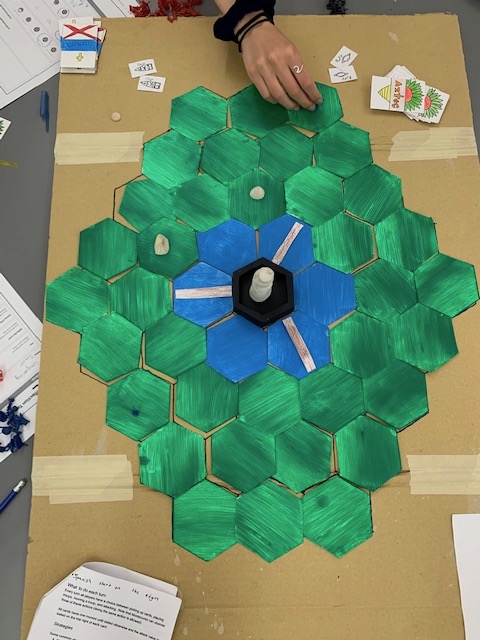
Anyway, they began prototyping their game following ideation. They used lo-fi materials to prototype in the beginning: paper and pencil. They created paper stand-ins for a board, meeples (did you know the little figures you play with on board games are called meeples?? Until this project, I did not!), cards, and rules. We spent just a couple of days creating these lo-fi models, because after this, we had them do a playtest. Groups switched games with another group, and they tested the games to see if they would work, and to see if they would be fun. They used the Playtest Reflection Template on page 31 of the Institute of Play's Game Design Pack to give the group feedback.

Following this, they iterated based on feedback. They changed rules, worked on the clarity of their rulebook, and altered game mechanics. Then they began working on a hi-fi version of their game. They used all kinds of materials like cardboard, paint, clay to make meeples, and our 3D printer. And then they played each others' games! They used the playtest feedback form once again to give the groups feedback as they played.


As we did with our Renaissance project, we used an assessment sheet to keep track of progress towards outcomes as they were working through this process. We once again wanted students to have opportunities to improve throughout this project, and so re-assessment was possible at any point during the work time they had for their game. I think in future iterations of this project, I would simplify the assessment sheet as it had too much to focus on and made mastery more difficult. 

Though it seems simplistic, the amount of content knowledge the students needed to know in order to make these games was quite astounding. They needed to make it historically accurate, and the outcomes had to reflect what really happened. Being able to create within those creative confines enabled great creativity - as you can see, each game is very different. Project-based learning can tend to go one of two ways: frontload the knowledge, and then have students create something to prove they know it, OR craft a performance task that gives the students a reason to find out the knowledge. The second type of project are the kinds I tend to gravitate towards. It works! This project proves that it does!

Resources Shared in this Post:


This project was co-designed with Tara.