Image Slider

Showing posts with label Self Instigation. Show all posts
Tuesday, December 09, 2014

Finding the Math in Recycled Christmas Lights

By Stephanie Bartlett
“These lights are longer than the ruler.”

Listening for the spark, I was ready when it came. We stopped everything and came over for a quick conversation and HG repeated his thought. As I held up the lights, more comments came and this was my chance to teach French oral language structures and vocabulary for mathematical reasoning.
“Those Christmas lights are taller than you.”
“I think they might stretch to the ceiling.”
“Do you think they are longer than the window?”
As students returned to their activities, some stayed to draw patterns using the lights as examples and to count the bundles of lights that our school is collecting to recycle in order to recover the copper inside.
At the end of the day, we gathered around the smart board to ask questions about what we could measure, how to measure accurately and how to make an estimation before measuring. Students divided into groups and drew their estimation first. Today, rather than artists or scientists, mathematicians would draw their guess in their journals before beginning to measure together.
 We thought that we could measure the length of the windows and collaborated peacefully to secure the lights along the length of the shelf below the windows.


Since we were sure a string of lights was longer than one student, we wondered if a string of lights would be longer than three students together. 

Tomorrow, the students will continue comparing, estimating and measuring the length of a string of Christmas lights. Some have mentioned that they want to attach the strings to see if they are longer than the hallway. It looks like one might find us learning in the hall...
Sunday, September 28, 2014

Alligator Tales

By Stephanie Bartlett
Around the time we were exploring metal and found objects, we left a photo of two metal alligator sculptures on the smartboard for students to discover. Many went immediately to sketch them. 


One student went so far as to create a materials list so that he could create his own alligator in the classroom.  We sent the list to the scrap metal yard, hoping they might donate some steel for us to play with.


One morning, as the sun streamed in the classroom, students entered to find a pile of steel on the carpet. First, they explored each piece. Then, with an adult acting only as a guide, an alligator began to take shape.

Conversation was lively as they compared and analyzed the picture and their own creation. Screws were painted for the teeth. "There are 27 teeth. I counted." "What will we use for feet?" 
We were fortunate enough to have a parent weld our alligator together. Our new metal friend then became the class mascot for the rest of the school year. The first day that she was delivered to our classroom, no one spoke. No one touched or even looked at her until the end of the day during our reflections. One girl whispered "Can we ride it?" Eyes lit up when I said yes. The next morning and every day after, students rode the alligator, read to her, cuddled (yes, cuddled) her, and paddled rapidly downstream on an imaginary river. 

At the end of the school year, we said goodbye and put her out in our courtyard garden for the whole school to enjoy. Last I heard, the grade two class would like to paint her. 

Wednesday, September 24, 2014

A Little Bit of Magic to Start the Day

By Stephanie Bartlett
Although I greet each morning with anticipation, rarely does the day begin with magic. We normally begin our day with about 15 minutes of activities that target fine motor development or skill competencies and then move on to the rest of our day. Until today.  One of the activities I had left out was a container of loose metal pieces and magnets for sorting, patterning and fine motor development.  When the group began to grow, I started to pay attention.
 “We need a screw driver thing.”
“We need wood.”
“How can we make a door?” 
“Can I help?”
“Here, hold this.”
 “We need instructions.”
“I can draw instructions. My mom is a designer.”
“I’m good at this. Here, let’s do it like this.”

 Now, if we are going to look at the seven strands of creativity, these students were touching on many of them without even trying. Collaborative Development, Experimentational Development, Analytical Development, Generative Development were all evident as students figured out what to make, how to assemble the materials and what to do when the first idea didn't work.  I sat listening and watching in awe wondering at what point the work of transforming my practice had arrived at a point where students were generating sophisticated ideas and creating on their own...in September!! 
So far, I think it is the culture I am co-creating with my students. I speak regularly to them about drawing plans and using the writing materials in every centre to explain their thinking. It must also be the predisposition that many of the students bring to the class, and the materials and tools in the maker space that are readily available for such explorations. Regardless of the reasons behind the magic, today I was spellbound and the feeling lingers on.  I got to know my students and their interests just a little bit more today and will sprinkle this magic liberally as the year gets going!
Thursday, May 29, 2014

Collaborative Spirit Fuels Creativity

by Stephanie Bartlett
Co-lab-o-ra-tionkəˌlabəˈrāSHən/
noun: collaboration; plural noun: collaborations1. 
the action of working with someone to produce or create something."he wrote on art and architecture in collaboration with John Betjeman
Last weekend I had the pleasure of attending and presenting at the Innovate West conference at Connect Charter School in Calgary. I was in the company of some amazing innovators.  No matter what workshop we attended, discussions were deep, thoughtful and forward thinking. Here is a common theme that resonated:
Collaboration is amplification. Just like they say at Pixar, when we collaborate we bring more depth, breadth and diversity to any topic than we could on our own. Collaboration is the driving force behind creativity in educational practice.  I was reminded of this as I attended Michelle Baldwin’s inspiring workshop on creativity.  Not only do we speak the same language and share the same enthusiasm, we cultivate the same message. Learn by doing. Laugh. Share. Reflect. Question. Collaborate. Repeat all of it as much as possible.
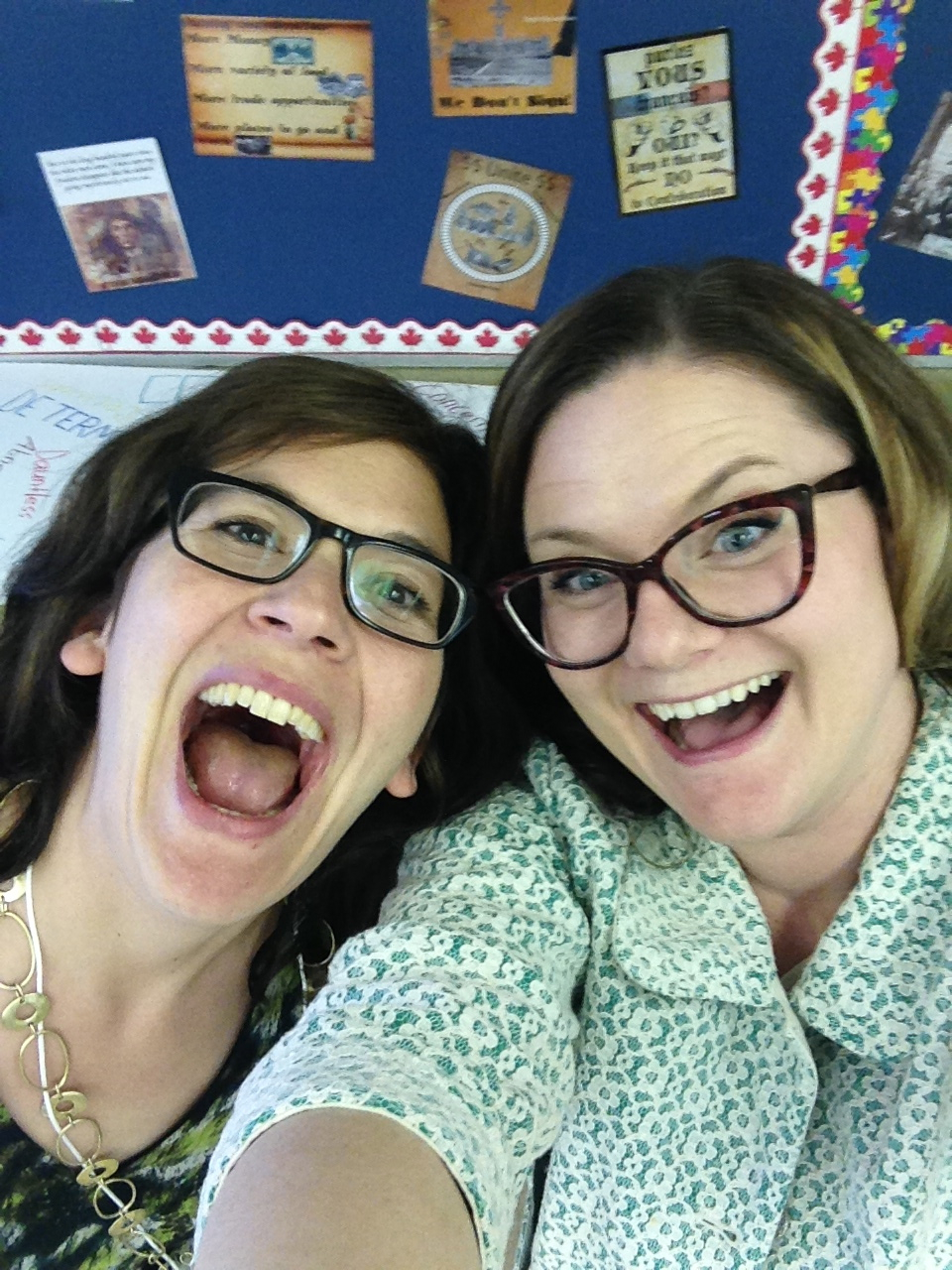
 And so, as Michelle thoughtfully guided us through an activity entitled The Selfie, where we had to take selfies that included reflection, perspective and shadow, I was reminded of the true spirit of creativity.
Friends, please follow  &  today. I just saw adults laughing, running around, taking incredibly fun & creative selfies.
  selfie challenge participants 


Engage in thoughtful task design embedded within play, laughter and choice within constraints and you will learn great things about yourself as a learner, the people you are working with and the subject at hand. And guess what? Through all that laughter and running around the room to capture the best selfies, we quickly established the mood and trust with strangers…so we learned, and we networked. It was an absolute pleasure meeting and learning with @luckybydesign, @michellek107, @MrodgersRodge, @chrisdittman @HeatherMMckay, @JaimeHatchette and @PaulKelba. I look forward to collaborating with all of you in the very near future.  #micdrop
                         
             Caught in the spirit of creativity with my CreativityCollective partner @luckybydesign
Tuesday, March 25, 2014

Looking Closely at Student-Owned Documentation

by Stephanie Bartlett

A big part of my journey this year has been exploring documentation panels.  Inspired by the many talented educators on twitter, I have read, thought, researched, reflected...and the cycle repeats.  I take photos and videos and must admit that I am still figuring out a process to post the photos in the classroom in a timely manner.  (I would appreciate any techniques from those well versed in the world of documentation panels.)
The other day, I printed the photos of our coconut explorations. I thought that if Hunter cut out the pictures, and we explained them together, then the panel would be meaningful to him rather than the parents coming for conferences as had been my original intention. He got some fine motor and sequencing practice cutting and ordering the pictures before we got ready to document the story.
I settled in with sticky notes and proceeded to be amazed at what I learned from Hunter. I thought he would label each event in each picture.  Instead, Hunter labelled the steps of collaboration. The first step was Hunter finding the coconut and exploring on his own. The second group of pictures was when Erik came to join him, the third was the class (spelled phonetically KSE) and the fourth was the opening of the coconut. 
Together we reflected on the different questions that he had been asking and I scribed those underneath.  The message had come through loud and clear for me and I was thrilled: collaborative development is an integral part of creativity in educational practice.  Hunter showed me in his own words that collaboration has been embedded in our classroom culture.
There is an important place for teacher-directed documentation panels to explain our programs to adults, and to celebrate the learning of our students by showing the thinking process.  Dylan William states in his book  Embedded Formative Assessment that "teachers have a crucial role to play in designing situations in which learning takes place, but only learners create learning." (William 158)  I provided the learning provocation and then the pictures; Hunter responded with a high level of engagement and showed me how students can help manage their learning process.  It is now up to me to take everything Hunter shared with me to help design new learning experiences for him and the class. 

Citation:

William, Dylan (2011.) Embedded Formative Assessment. Bloomington, IN: Solution Tree Press
Wednesday, March 19, 2014

Coconut Tales: Looking Closely At One Student's Spark

By Stephanie Bartlett

Hunter discovered a coconut in our Looking Closely centre.  He spent activity time looking closely, listening to the water inside, wondering and drawing in his journal.  "I wonder how we can crack this open?" He is a collaborative guy, so he quickly found a friend to share his discovery.  The group began to grow and our class discussion at the end of the day was all about whether we could open the coconut the following day and how we might do that.

The next day, I had my tools ready: screw driver and hammer to open the coconut in a fairly teacher-directed fashion.  Sure enough, a gang of them headed towards the unsuspecting coconut, each armed with scissors. The snippets of excited discussion I heard were the very things that I had been teaching all year.  They were talking, wondering, figuring out how to open the coconut and all the while, finding ways to listen and work together. I stopped the whole class and quickly told them there were some people who wanted to crack the coconut.  I asked everyone to just drop their toys, grab their journal and draw how they thought we might open it.  

Next we all gathered around the table.  When I turned back from gathering my tools to demonstrate how to do open our treasure, I saw that Rowan (who had just returned from a five month stay in Maui) grabbed the coconut, and used his scissors like a screw driver in one of the holes, saying "Let me do this. I used to open these every day."  What empowerment for a student who is working hard to return to routine, school, all the while learning a new language! There was no need for me to be there, so I quietly hung back and let him run the show.  

The conversation turned to excitement about the water inside. "What will it taste like?" "Can we try it?" Like a surgical assistant hoping to be helpful, I grabbed our class set of cups and suggested that everyone pour two shakes in so that they could all try the water.  So fun! And then...after some French oral language activities because I need to get them talking as much as I can...we counted to three and tried the coconut water.  "Eeeewwwww!" "Gross!" 
The last step was to graph who liked the taste and who did not.  We ended the day chanting "Je n'aime pas l'eau de coco!" 
This activity was made possible by a provocation that sparked the curiosity of one student. Then, he shared his interest and collaborated, all the while generating ideas on how to open the coconut.  Students then caught the spark and drew a plan.  This gave them an opportunity for authentic writing, then math and oral language skills.  Listen carefully to your students, teach them to wonder, question and investigate and offer provocations that will allow their curiosity to spark.  To me, this is a joyful way to teach and the results always astound me. What examples do you have that highlight student engagement?
Monday, March 03, 2014

Blow, Blow, Blow Your Boat

by Stephanie Bartlett
A play-based program is the ultimate backdrop for the most incredible learning opportunities.  It is our job as educators to pay attention and listen carefully. As facilitators, we  can then offer tools and experiences for students to become mindful learners, all in the midst of play.  Take boats, for example.
Over the course of the last couple of months, B, H and C have often sat and drawn pictures of boats.  We have hung them on the wall near our water table and I have waited for the right moment to take their learning to a deeper level.  It all came together this week when many students were involved in a pirate game.  They created treasures to hide and drew maps for everyone to take part. (Hello, collaboration!!) For two days, I watched and listened carefully, wondering how to decide the best way to guide their thinking. I asked my three students to sit the next day and draw plans for boats they could build.  Their plans initiated a class discussion about motor boats and sail boats, and pirate ships, of course!

 B went to the next step and created a materials list.


The next day, B arrived and spent a large amount of time building a model boat out of popsicle sticks, telling me "I thought and thought at home about how I could build a boat with buttons, popsicle sticks and string. This boat collects garbage on the ocean and I need to build a claw on the back."


Coincidentally, my colleague mentioned earlier in the week that she had many students who were very taken with machines, motors and boats in particular.  There was my point of convergence. We could create boats together!  As a team, we have decided to offer the opportunity to students in all three of our kindergarten classes to work together. Today, we had two parent volunteers come in and set up an area with materials, paper and writing tools to draw plans and a tub of water to test for seaworthiness. Knowing that sparks catch fire, we started this idea with the interest of a few students, knowing that others would jump on board, so to speak. The environment was focused and highly engaged. There was a quiet hum of happiness and excitement, peppered with observations, in the most natural form of analytic thinking and feedback.  

"I think your boat is leaning too far to one side." 
"How can I get my boat to move?" 
"You need some wind. Can you blow?"
"Mine is sinking." 
"My boat is heavy on one side. It keeps leaning."

Some students drew plans and then proceeded to build without referring to their plan.  There is an interesting focus point for the next projects, always keeping in mind that some learners are unable at this point to articulate what their plan is before they execute and we believe that is ok.


Others, drew their plans and build their boats accordingly.


Genius Hour has been very fluid in my class this year.  My original intent was to spend every Friday morning engaged in different projects.  In the ever-changing world of Kindergarten, if students are protopying an idea or developing an idea, they are not all going to put it away until the following week...they will keep playing until they are ready to discover new things or play with different people.  So, on Fridays when I have two parent volunteers, I now create the space and provide the materials for students who are experimenting with certain ideas. 
As educators, we can help students discover new concepts and play with intention. Teaching without themes in the traditional sense of the word is perhaps best understood through the lens of creative development.  The vocabulary and disposition of creative development is the common thread that helps my students to open their minds and apply the skills we are learning in a very real context that is relevant to them.  
What's next? On Monday morning, when the students enter the room, their boats will be waiting for them.  Will they return to their boats and continue tweaking their models? Will others have decided that they would like to build another prototype? Will they play with their boats in the water table? Will some draw another picture or write a story? Will they naturally group the different types?


One thing is certain: I will be nearby, listening to the feedback and analytical development and watching the magic of engaged students, waiting for the next possible spark.