Image Slider

Wednesday, September 03, 2014

Music...It's Instrumental

By Stephanie Bartlett

Time. We need the slowness of time to really learn and explore a topic and sometimes this is very difficult to honour. I took the time to reflect this summer on some of our projects that best demonstrate my journey as I learn how to slow down and really take the time to figure out what really matters in our classroom. I am beginning to discover that no matter what the program of studies may ask us to teach, it is the topics that invite passion and wonder that allow us to cover curriculum deeply. I share this story as an example of how to take an idea, be it student driven, teacher driven, or both and transform it into a spark that can develop into an in-depth inquiry.

Before Earth Day, there was a cbc.ca challenge inviting bands to perform a song using found objects as instruments. At first,we watched the videos, looking closely at the instruments. Then instruments and objects were left out for exploration.  

After a couple of weeks, students chose an instrument and played along, finding the rhythm of the song. The result each time was a heartbreakingly beautiful moment of synchronicity. Students moved to the music, found the beat with their instruments and some sang. Everyone was engaged. No one noticed their teacher willing this moment of learning to suspend us in a calm space amidst a busy morning. 

Collaboration moved us forward to the next level when we visited the grade 3/4 classes to see the instruments that they had created. Never underestimate the power and influence of the big kids. Each kindergarten student was paired with an older child who carefully explained their instrument and the process in which they had created an instrument of their choice to reflect changing tone and pitch.  In small groups mixed with older and younger students, they worked to compose a rhythm together.
Back in the classroom, we saw a rapid change in the variety of instruments created and increased complexity in the rhythms. We started to create songs in small groups. Some students even ventured to record their music in photo booth. We did not work on this every day, nor did I have a set outcome. My dream goal was a big one: to present their songs at our end of the year celebration.  If we didn't get there, I was ok with that because the process of creative development was rich. Formative assessment was ongoing and curriculum was integrated and covered just by the students immersing themselves in the process. Some were more involved than others and that was ok. There are always leaders, innovators and instigators at any age.
The last step was to visit the older buddies one last time to watch their music videos. Students explained the criteria to the kindergarten students...once again the results of collaboration amazed me. We had some very interesting percussion and string instruments and the work of the rock bands began to take shape.
The students presented proudly at our class celebration, showing parents and myself that given time, guidance and patience, an amazing inquiry can keep momentum over a longer period of time, covering more curriculum than one would ever think possible. Jackie Seidel, my professor in Graduate Studies at the University of Calgary, writes in her essay 'A Curriculum for Miracles' that:
                   
                     a Curriculum for Miracles understands that life can be opened from this
                     wonderous place called a classroom or school, or it can be closed. Life can
                     be seen as wonderous or as dull. It can creatively overflow with joy, justice,
                     peace and love, or it can serve the future, the literal, the non-miraculous...
                     thus a Curriculum for Miracles is a curriculum that knows life itself as an
                     Object of Wonder.  Fragile. Unique. Interconnected. Just once. (Seidel, 2014)

Echoing Jackie Seidel's thoughts, it is a living curriculum that takes precedence in my program. One of hope, one that allows students to voice and develop their ideas. Giving up my need to control everything that goes on in the classroom and co-developing my program has been instrumental in my shift towards teaching and learning a curriculum that celebrates the joys, the sorrows, and the passions of all stakeholders.

Citation:
Seidel, Jackie (2014). A Curriculum for Miracles. In Jackie Seidel and David W. Jardine (Eds.), Ecological Pedagogy, Buddhist Pedagogy, Hermaneutic Pedagogy: Experiments in a Curriculum for Miracles. 

Scrap Metal: Lessons in Sustainability

By Stephanie Bartlett
It began with the spark of one student.

Departing from the typical get-to-know you activity at the beginning of last year, I invited students to bring five photos that defined who they were.  I asked parents to think deeply about the fabric of their family. What were the passions and curiosities of their five year old child? What made their child laugh? What are the stories that helped shape who their child is today?

For the first few weeks of school,  Blaze was quiet and reserved.  I wondered how I could connect with him and find out what made him tick. It turns out that the wheels were already in motion with our photo project. When it was Blaze's turn to present his favourite picture, he chose a picture of a machine with a giant claw. His voice became as deep and matter of fact as a man's, and as mesmerizing as a storyteller's as he proceeded to inform the class that this was his own scrap metal yard and that he had two of these machines. He explained that the machines smashed and sorted metal, which was then put in a container and sent to China where it would be reused. Blaze went on to say that he often went to work after school, and that he had his own office with a computer.  And there was the hook! This five year old child was already so engaged in a real world context that a classroom full of toys and large group lessons had precious little value to him at that moment.  After asking Blaze's parents if we could visit the scrap yard later in the year, I started to think about how we could use Recon Metal as a real, authentic example within our local community to learn about sustainability and the life cycle of an object. I started to ask myself what really matters in the context of teaching the curriculum and discovered for myself that learning is much more engaging when it is based on the real life and when it directly addresses the passions of our students.

Fast forward to April, a few weeks before Earth Day.  We set the date for our field trip and began to spend time exploring the field of environmental sustainability. We began the month by learning about recycling of different materials through videos, literature and discussions. The students explored and played with wire, and different found objects. Students created art projects, storyboards for movies, and books, all of which showed the process or importance of reusing and recycling.

On the day we visited the scrap metal yard, the students disembarked from the bus, donned t-shirts and hard hats and began the tour. We watched a machine load a shipping container bound for China and  watched a car get smashed by a giant magnet. We ran our hands through shredded copper and aluminum, and sorted different metals. All in all, it was an unforgettable day.


But the best part? The next day, when we reflected together, the students really understood the message. Their comments demonstrated a basic understanding of the life cycle of an object. An object can be used, recycled, shipped somewhere else and created into something new, like a new toy car, for example. And that is the bottom line when we are teaching a new generation to care for our planet and our future.
Thursday, May 29, 2014

Collaborative Spirit Fuels Creativity

by Stephanie Bartlett
Co-lab-o-ra-tionkəˌlabəˈrāSHən/
noun: collaboration; plural noun: collaborations1. 
the action of working with someone to produce or create something."he wrote on art and architecture in collaboration with John Betjeman
Last weekend I had the pleasure of attending and presenting at the Innovate West conference at Connect Charter School in Calgary. I was in the company of some amazing innovators.  No matter what workshop we attended, discussions were deep, thoughtful and forward thinking. Here is a common theme that resonated:
Collaboration is amplification. Just like they say at Pixar, when we collaborate we bring more depth, breadth and diversity to any topic than we could on our own. Collaboration is the driving force behind creativity in educational practice.  I was reminded of this as I attended Michelle Baldwin’s inspiring workshop on creativity.  Not only do we speak the same language and share the same enthusiasm, we cultivate the same message. Learn by doing. Laugh. Share. Reflect. Question. Collaborate. Repeat all of it as much as possible.
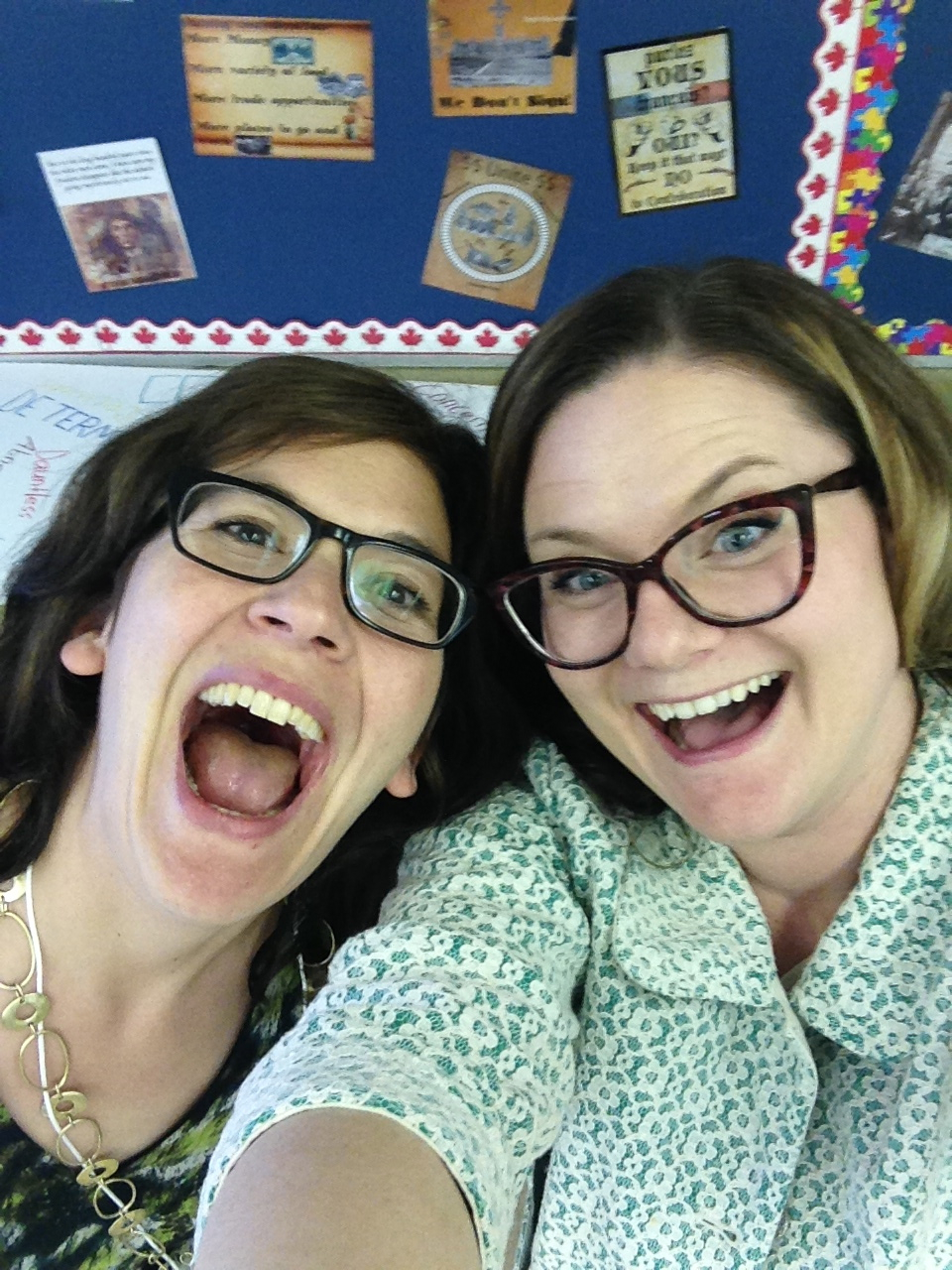
 And so, as Michelle thoughtfully guided us through an activity entitled The Selfie, where we had to take selfies that included reflection, perspective and shadow, I was reminded of the true spirit of creativity.
Friends, please follow  &  today. I just saw adults laughing, running around, taking incredibly fun & creative selfies.
  selfie challenge participants 


Engage in thoughtful task design embedded within play, laughter and choice within constraints and you will learn great things about yourself as a learner, the people you are working with and the subject at hand. And guess what? Through all that laughter and running around the room to capture the best selfies, we quickly established the mood and trust with strangers…so we learned, and we networked. It was an absolute pleasure meeting and learning with @luckybydesign, @michellek107, @MrodgersRodge, @chrisdittman @HeatherMMckay, @JaimeHatchette and @PaulKelba. I look forward to collaborating with all of you in the very near future.  #micdrop
                         
             Caught in the spirit of creativity with my CreativityCollective partner @luckybydesign